Chinese Astronauts to Stay in Space Station for One Year
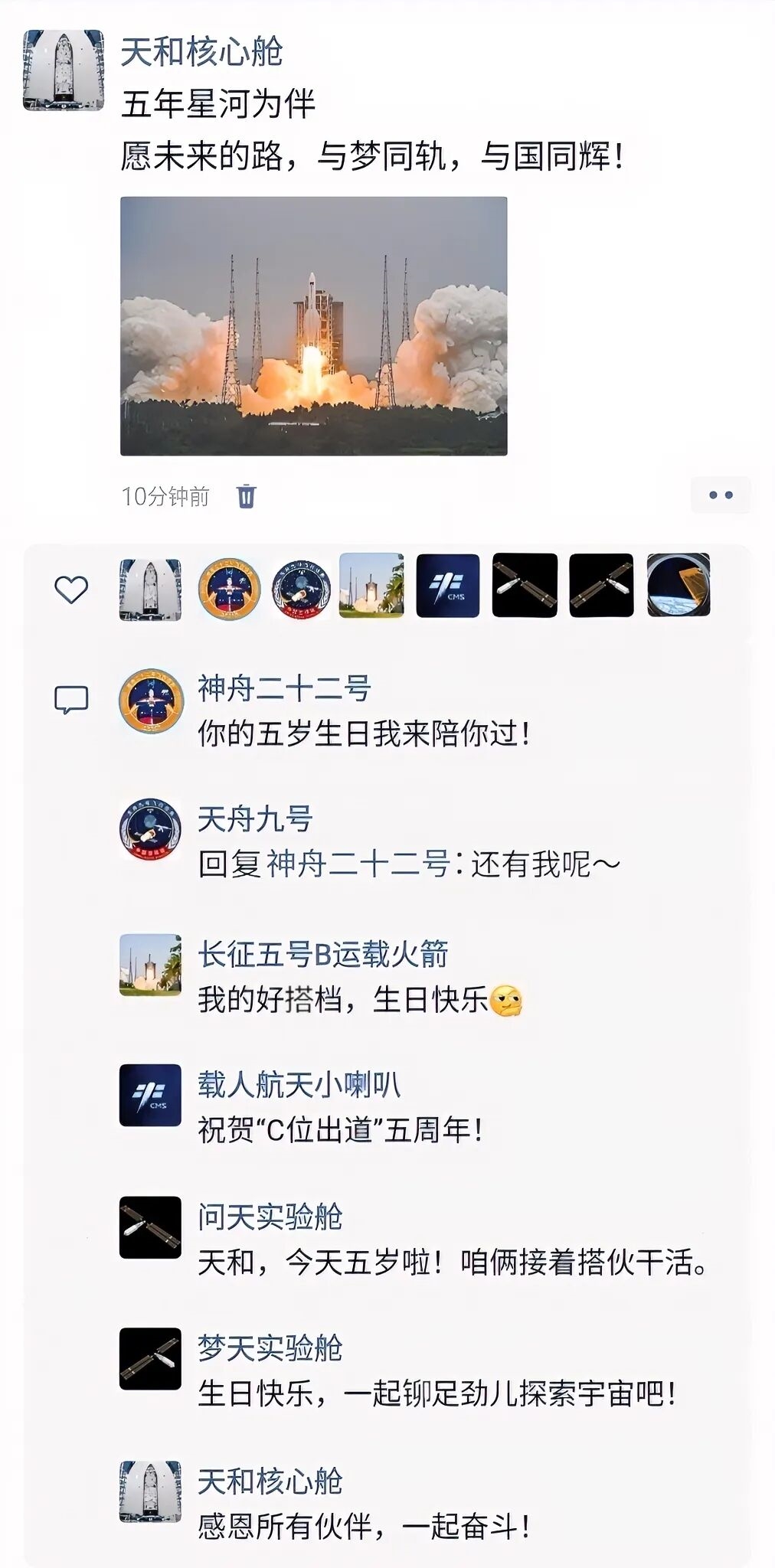
Today, April 29th, marks the 5th anniversary of the stable in-orbit operation of China's space station core module, Tianhe. Five years ago today, the Long March-5B Y2 carrier rocket, carrying the Tianhe core module, ignited and launched from the Wenchang Space Launch Site in China, sending the first "building block" of the "Tiangong" space station into space.
The Tianhe core module is the first cabin segment launched into orbit for the Chinese space station. It is 16.6 meters long with a maximum diameter of 4.2 meters and consists of a node cabin, a small cylindrical section, a large cylindrical section, a rear passage, and a resource cabin, providing astronauts with a space for scientific research and living.
As the "intelligent brain" and central hub of the space station, the Tianhe core module plays a key role as the space station's management and control center. It is mainly used for unified control and management of the space station, supporting the rendezvous and docking of experimental modules, manned spacecraft, and cargo spacecraft, supporting space science experiments, and is also the main living area for astronauts.
The Tianhe core module is equipped with six areas: a work area, a sleeping area, a hygiene area, a dining area, a medical monitoring area, and an exercise area. It not only ensures that each astronaut has an independent sleeping environment but also features a microwave oven, refrigerator, water dispenser, and folding table in the dining area, as well as fitness equipment such as a space treadmill to meet the astronauts' daily exercise needs.
During its five years in orbit, the Tianhe core module, as a "veteran" segment, has witnessed the docking and transposition of the Wentian and Mengtian experimental modules, forming the space station's "T" shape. It has welcomed the docking of 11 Shenzhou manned spacecraft and 8 Tianzhou cargo spacecraft, receiving 10 astronaut crews and a total of 25 Chinese astronauts.
The Tianhe core module in orbit welcoming visiting spacecraft.
Over the past five years, as a national space laboratory, the space station has carried out a number of cutting-edge and innovative space science, application experiments, and technology trials, covering four research areas – space life and human research, microgravity physics, space astronomy and Earth science, and space new technologies and applications – with 32 research topics.
As of the end of 2025, 267 scientific and application projects have been deployed and implemented in orbit, with a cumulative 9 batches of experimental samples downloaded and over 450TB of scientific data acquired in orbit.
The world's first genetic resources of rice grown in space and regenerated rice, the first successful differentiation of human embryonic stem cells into hematopoietic stem/progenitor cells in space, the first space station sub-magnetic-microgravity composite space environment biology research, and the first space station pipeline inspection robot in-orbit test…
Some of the results have been transferred, transformed, and promoted, significantly boosting the rapid development of China's space science and applications.
Astronaut crews conducting space science experiments in orbit.
China Space Station Science Research and Application Progress Report
Over the past five years, China has conducted a cumulative 26 spacewalks and multiple application payload spacewalks, with the Tianhe core module node cabin supporting the completion of 5 spacewalk activities.
Astronauts have carried out spacewalk activities as planned, verified related technologies, conducted extravehicular assembly, implemented extravehicular repairs, and conducted active protection, continuously breaking records for the number and duration of spacewalks, creating new world records.
Currently, the Chinese space station is operating stably in orbit and achieving good benefits.
Chinese astronauts conducting spacewalk activities.
This year, the Chinese manned space program plans to implement one cargo spacecraft resupply mission and two manned flight missions.
Astronauts from Hong Kong and Macau are expected to perform a space station flight mission as early as this year, with one astronaut from the Shenzhou-23 flight crew conducting a one-year residency experiment.
In addition, the research and construction of the lunar landing phase of the manned lunar exploration project are progressing smoothly, achieving multiple stage breakthroughs.
As of now, the development of major flight products such as the Long March-10 carrier rocket, the Mengzhou manned spacecraft, and the Chang'e lunar lander is progressing smoothly.
Several large-scale tests, such as the low-altitude demonstration and verification of the Long March-10 carrier rocket system and the maximum dynamic pressure escape flight of the Mengzhou manned spacecraft system, have been completed one after another.
The project will also fully promote the construction of the Wenchang Space Launch Site and related supporting facilities for the lunar landing mission, as well as ground support systems such as measurement and control communication and landing sites, aiming to achieve the goal of China's first landing on the moon before 2030!
The research and construction of the lunar landing phase of the manned lunar exploration project are progressing smoothly.