Windows Monthly Updates Have Swollen to 5GB, a 16-Fold Increase in Two Years
According to an in-depth investigation by WindowsLatest, the size of Windows 11 monthly cumulative updates has swelled from approximately 300MB in 2024 to 5GB in 2026, and nearly 9GB when uncompressed. While AI features have contributed to some of the increase, the design of the update mechanism itself is the root cause of the continued expansion in size.
AI Components: Where Did the 3GB Increase Come From?
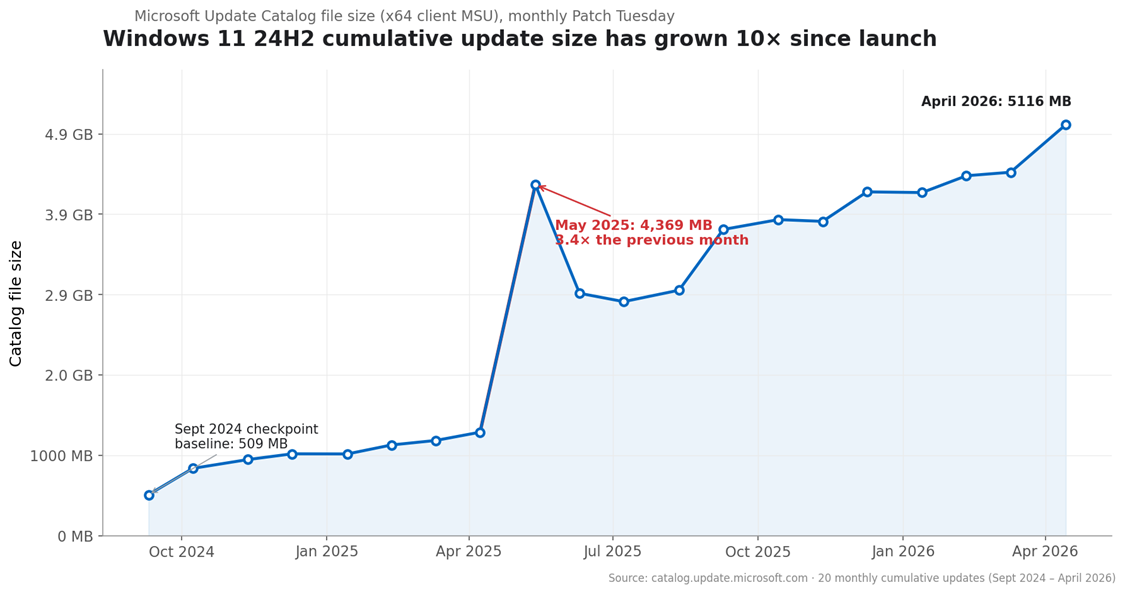
The cumulative update in May 2025 was a key turning point. The update package size jumped from approximately 1.3GB to 4.4GB, and the uncompressed size jumped from 6.5GB to nearly 9GB.
WindowsLatest unpacking analysis revealed that the increase primarily comes from dozens of previously non-existent MSIX components, all related to semantic search and local AI inference. This approximately 3GB increase can be largely attributed to AI components.
A key detail here is that these AI components were initially designed only for Copilot+ PCs. As support expanded to Intel and AMD platforms, more versions were crammed into the same update package.
Windows Update’s applicability check logic detects hardware configuration before downloading and only pulls the parts the system actually needs. Testing on a virtual machine without an NPU, the 4GB+ catalog package actually downloaded only about 1.7GB, and the semantic search component was not pulled.
In other words, AI components are packaged into the update, but a large number of users’ computers will not install them at all.
Technically, these AI models and semantic search components could be distributed separately via the Microsoft Store or on-demand download, decoupling them from the monthly cumulative update. Microsoft has not done so yet.
Cumulative Update Mechanism: The True Root of Volume Expansion
Windows 11 uses the latest Cumulative Update (LCU) mode. Each month’s security update includes the fixes for that month as well as all historical fixes. Even if your computer only needs a small patch, the update package still carries the complete changeset required to upgrade any system to that version.
This mode is clean from a reliability perspective, ensuring that installing the latest update ensures the system is fully updated, even if previous updates were skipped. However, the side effect is that update packages only get bigger and never smaller.
Microsoft introduced checkpoint cumulative updates in Windows 11 24H2 in an attempt to mitigate this issue. The idea is to establish new baselines periodically, with subsequent monthly updates containing only changes since the last checkpoint, thereby reducing the size.
After the first checkpoint was established in September 2024, updates through April 2025 did maintain a relatively small size. However, the May 2025 update volume increased threefold, and no new checkpoints have been established since then for over a year. Microsoft’s promised volume optimization is quietly failing.
Enterprise Side: Costs Soar Fourfold
For home users, the actual download size is much smaller than the catalog package size, and most people won’t notice the 4-5GB figure. However, enterprise environments do not have this flexibility.
WSUS downloads the complete cumulative update each month, Configuration Manager distributes the complete package to each distribution point, and the Offline Servicing Tool injects the complete MSU package into system images. Each scenario requires the complete package, even if a single endpoint only uses a small portion of it.
WindowsLatest calculated that the annual update storage cost per architecture per distribution point has increased from approximately 11GB in 2024 to 52GB in 2026, an increase of more than fourfold.
An organization with 5 distribution points occupies more than 250GB of disk space each year per architecture for update files alone, and this does not include savings from regular cleanup.
Comparison with Apple
macOS incremental updates are typically in the 1-3GB range, with larger volumes appearing only with major version jumps, mainly because there are far fewer hardware versions than Windows.
Apple also does not have a fixed monthly update schedule, releasing updates when they are ready, and has greater flexibility in how changes are packaged. Windows prioritizes compatibility, predictability, and deployment capabilities in an extremely large combination of hardware and software configurations.
WindowsLatest concludes that the reason Windows updates are so large is because they are designed to run in any configuration and in any enterprise scenario. Microsoft is already trying to reduce the size, but the package itself continues to grow.