DLSS 4.5 Crushes AMD FSR 4.1 in Blind Test, Players Actually Prefer Upscaled Images
Recently, German tech media ComputerBase published the results of a large-scale blind test, inviting players and hardware enthusiasts to compare the image quality of NVIDIA and AMD's latest upscaling technologies. The test involved seven contemporary games: *Pax Romana*, *ARCRaiders*, *Assassin's Creed Shadows*, *Call of Duty: Black Ops 7*, *Kingdom Come: Deliverance 2*, *Resident Evil 4*, and *The Last of Us Part I*.
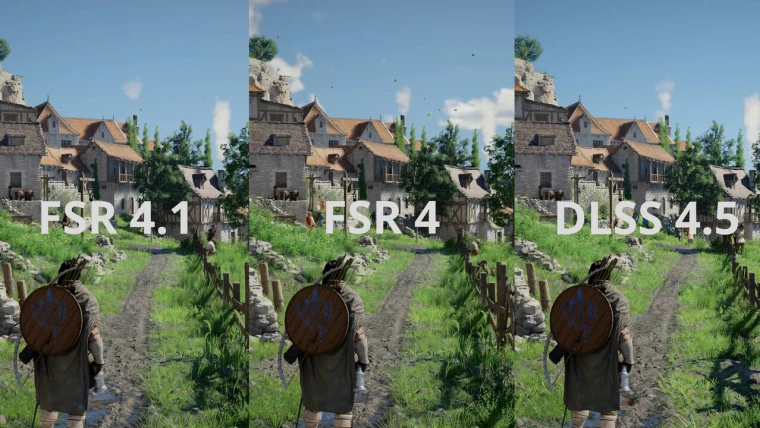
All screenshots were generated using FSR 4.0, Enhanced FSR 4.1, and DLSS 4.5 (Quality mode), and participants were unaware of which technology each image corresponded to, ensuring absolute objectivity.
According to the voting results, NVIDIA DLSS 4.5 achieved a resounding victory in six out of the seven games. Users generally found its details clearer, dynamic scenes more stable, and frame generation effects more natural. The only exception was *Resident Evil 4*, where FSR 4.1 surprisingly won.
Despite losing in most categories, experts and the community agree that AMD has made a significant leap forward. FSR 4.1 shows significant improvement compared to FSR 4.0, and in some scenarios, its image quality is almost indistinguishable from DLSS 4.5.
Notably, players increasingly preferred the upscaled images over native rendering during the test. This clearly demonstrates that modern AI algorithms can not only effectively improve performance but also enhance visual perception.
Experts point out that the next stage of evolution in upscaling technology will inevitably be linked to neural rendering. NVIDIA's DLSS 5.0, announced at GTC 2026, and the neural texture compression demo have already taken the first step, the latter significantly reducing VRAM usage. At the same time, AMD is continuously optimizing FSR, preparing to launch a new version that more closely matches its competitor. The competition in upscaling technology will continue, and the ultimate beneficiaries will be the vast majority of players.