Nuclear Power Plants Develop a New Side Business: Pearl Production
A nuclear power plant in Changjiang Li Autonomous County, Hainan Province, has a surprising byproduct – pearls. This article explores how a nuclear power plant can produce pearls and addresses concerns about potential radiation in the pearls.
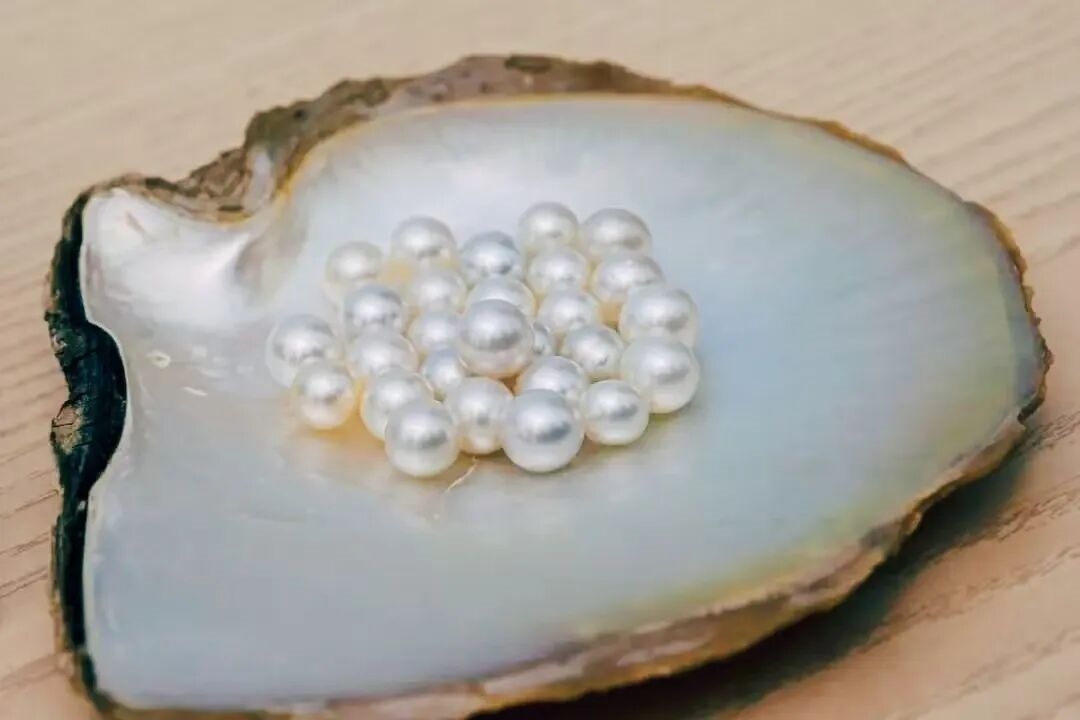
Nuclear White Butterfly Shell Pearl Finished Product, Image: Liu Xuan
Large Pearl Oyster – Producer of “Australian White” Pearls
To be precise, it’s not the nuclear power plant producing the pearls, but the pearl oysters – large pearl oysters, also known as white butterfly oysters – cultivated in the waters around the plant.
Large Pearl Oyster, Image Source: Wikipedia
You may not have heard of this type of oyster, but the pearls it produces are among the gems of the pearl world – the Australian White. It’s called “Australian White” because Australia was historically the main source of these pearls.
Of course, the Philippines, Indonesia, and other places can also produce these pearls, so they are also known as “South Sea Pearls.” Our country also has a distribution of large pearl oysters, mainly concentrated in warmer waters, such as the Leizhou Peninsula, the southernmost part of Guangdong Province, Hainan, and Taiwan.
“South Sea Pearls” from Indonesia, Image Source: Wikipedia
Since the 1960s, people have extensively harvested large pearl oysters to obtain them. They are now listed as a national second-level protected animal.
These shellfish have very high requirements for water quality and environment, making large-scale cultivation and the production of high-quality pearls very difficult, which is why “Australian White pearls” are so precious.
However, understanding the reasons, why is it specifically around nuclear power plants that large pearl oysters can be cultivated? This is actually a “win-win” situation between nuclear power and large pearl oysters. To understand this, we need to start with the cooling water and warm water discharge from nuclear power plants.
Cooling Water and Warm Water Discharge
The current mainstream principle of nuclear power generation is to use the heat generated by the nuclear reactor core to boil water. The steam produced boils water, which drives the turbine blades, converting kinetic energy into electrical energy.
After the steam completes driving the turbine, it is not directly discharged, but needs to be re-cooled into liquid water and then recirculated. This process of re-cooling the steam into liquid water requires a large amount of cooling water.
For coastal nuclear power plants, the cooling water is naturally drawn from the surrounding sea. After completing the cooling task, the cooling water also needs to be discharged back into the sea. The temperature of this water discharged back into the sea is often higher than the surrounding seawater, so it is also called “warm water discharge.”
This warm water discharge entering the environment may have a certain impact on the surrounding marine ecosystem, so specialized assessments are required before the construction of a nuclear power plant to ensure it doesn’t harm the ecology.
When the Changjiang Nuclear Power Plant was established, it also underwent such an assessment to ensure that the warm water discharge would not damage the surrounding ecosystem. However, the Changjiang Nuclear Power Plant went a step further, reusing the heat from this warm water discharge, truly making the most of “waste heat.”
Schematic Diagram of Pearl Production by Shellfish, Image Source: Shanghai Natural History Museum
A “Win-Win” Situation Between Nuclear Power Plants and Large Pearl Oysters
As we mentioned earlier, large pearl oysters like warm waters, and the warm water discharge from nuclear power plants can maintain a warm water temperature in a small area around the plant.
This provides conditions for large-scale cultivation of large pearl oysters.
At the same time, when choosing a location, nuclear power plants also choose sparsely populated areas with relatively stable hydrological conditions, where the seawater quality is generally good, which is another necessary condition for the growth of large pearl oysters.
In addition, there is another important factor that makes nuclear power plants and large pearl oysters a “win-win” situation.
The increase in water temperature caused by warm water discharge may cause a large proliferation of phytoplankton in the waters around the nuclear power plant. If phytoplankton proliferates too vigorously, it may cause marine disasters such as red tides (simply understood as algal blooms).
Some algal blooms may block the intake of cooling water for the nuclear power plant, endangering the safety of the plant. Engineers at the nuclear power plant need to find ways to reduce the occurrence of such disasters.
Large pearl oysters, as filter-feeding shellfish, have phytoplankton as one of their main food sources. Therefore, cultivating large pearl oysters around nuclear power plants can alleviate the problem of excessive phytoplankton growth to a certain extent.
Large pearl oysters get a full belly, allowing them to grow healthily and produce pearls. Humans have eliminated the potential red tide crisis around the nuclear power plant, which is why large pearl oysters and nuclear power plants are a “win-win” situation.
Will Pearls Produced by Large Pearl Oysters Have Radioactivity?
The next question is, will the pearls cultivated in the waters around nuclear power plants be contaminated with radiation? In fact, the warm water discharge from nuclear power plants does not bring radiation contamination.
First, the warm water discharge from the nuclear power plant does not directly contact the reactor core, nor is it even a secondary contact.
The Changjiang Nuclear Power Plant’s reactor is a pressurized water reactor. Its core does not directly contact the water being heated, and the cooling water is used to cool this heated steam.
During cooling, the cooling water does not directly contact the steam, so it is very far from the “radiation source.” This water is completely different from the controversial nuclear wastewater.
|
Cooling water is only in the red box area and does not directly contact the core, Image Source: Wikipedia
Second, to ensure safety, this cooling water is also tested for radioactivity before being discharged into the sea, and is only discharged when it meets the standards. Therefore, we don’t need to worry about the pearls produced by large pearl oysters having radioactivity.
Moreover, large pearl oysters are a very “delicate” shellfish. The fact that such delicate shellfish can grow here and produce high-quality pearls is the best proof of the water quality in this area.
The cooperation between the Changjiang Nuclear Power Plant and the large pearl oyster cultivation can be said to be a model of industrial cooperation. The warm water discharge, which once troubled the nuclear power plant, can now make the most of “waste heat,” allowing large pearl oysters to grow better.
In return, large pearl oysters consume a large amount of proliferating phytoplankton, eliminating the potential threat of red tides, while also nurturing precious pearls – a “triple win.”
References
[1] Environmental Impact Report (Operation Phase) of Units 3 and 4 of Hainan Changjiang Nuclear Power Plant https://www.mee.gov.cn/ywdt/gsgg/gongshi/wqgs_1/202411/W020241125352282968236.pdf
[2] Guangzhou Ocean University, “Large Pearl Oyster” https://bwg.gdou.edu.cn/info/1021/1024.htm
[3] Southern Weekend, “The South of the Sea, the Tide of Nuclear Power: What does a pearl-producing nuclear power plant look like?” https://www.infzm.com/contents/280201?source=131
Planning and Production
This article is a supported work of the Science and Technology China · Creation and Cultivation Plan
Produced by 丨Department of Science Communication, China Association for Science and Technology
Supervised by 丨China Science and Technology Publishing House Co., Ltd., Beijing Zhongke Xinghe Culture Media Co., Ltd.
Author 丨Science Corner, Science Popularization Creator
Reviewed by 丨Dai Li, Senior Engineer of Cold Source Safety, China National Nuclear Corporation
Planned by 丨Zhang Linlin
Editor-in-charge 丨Zhang Yinuo