Institutions Predict Nearly Half of Global Smartphones Will Have Satellite Connectivity by 2030
Counterpoint Research's latest study indicates that smartphones with non-terrestrial network (NTN) connectivity are entering a critical growth phase, projected to account for 46% of global smartphone shipments by 2030. The report suggests that market growth in the coming years will be primarily driven by manufacturers like Apple, Samsung, Google, and Huawei, with high-end models remaining the primary carriers of satellite communication smartphones.
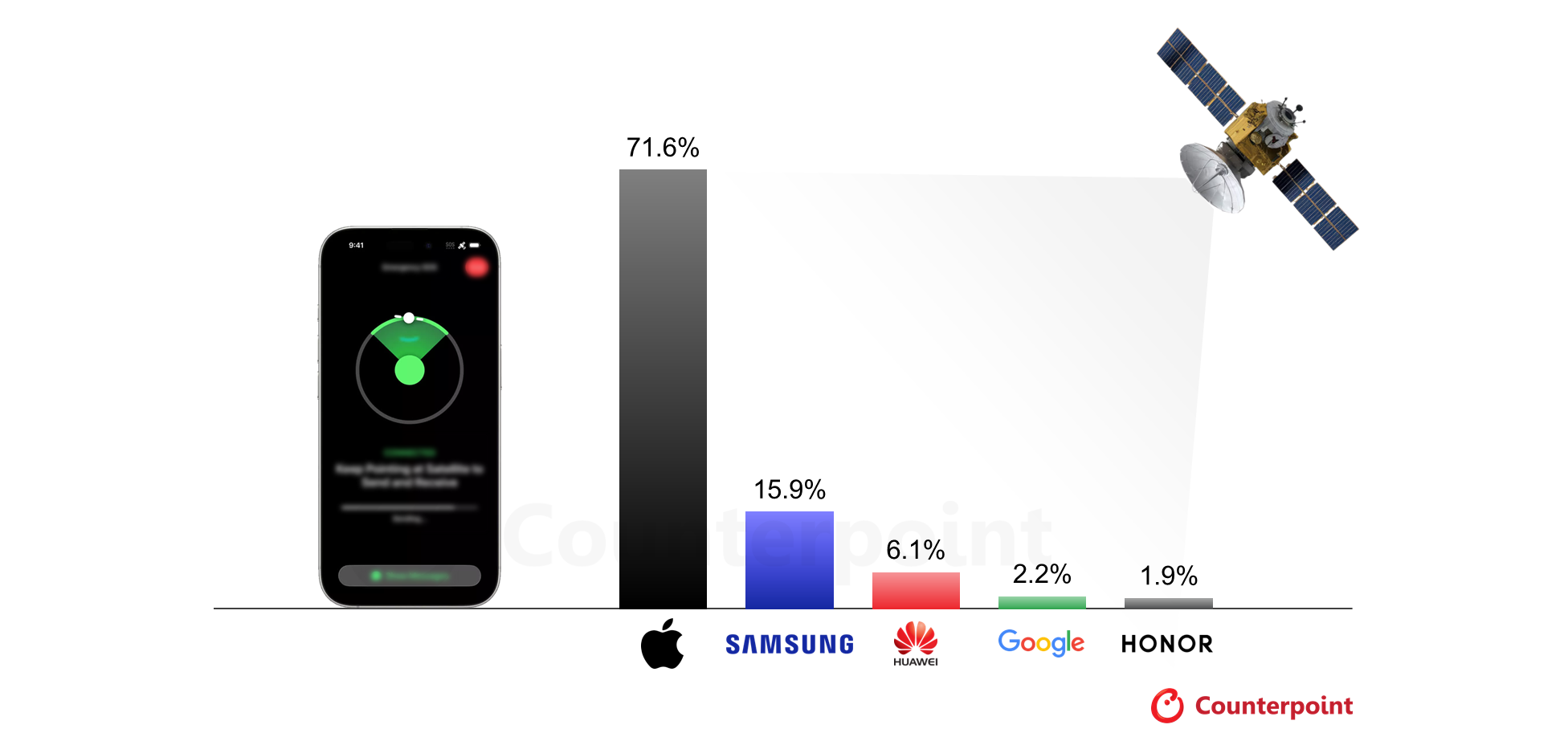
The report points out that in the short term, the market will be driven more by proprietary solutions led by various manufacturers, while the 3GPP-standard-based NTN ecosystem still faces practical challenges such as chip readiness, operator certification, and insufficient service maturity. This also means that although satellite connectivity has become one of the differentiating capabilities of smartphones, the industry is still some way from true large-scale popularization.
Looking at the development history of the industry, Apple was the first brand to bring satellite connectivity to the mainstream smartphone market, introducing the capability to the iPhone 14 through a partnership with Globalstar in 2022. The report also mentioned that Amazon's recent acquisition of Globalstar not only allowed it to quickly enter related infrastructure but also opened up new commercialization space for it in the "Connectivity as a Service" field. Huawei became the second manufacturer to bring satellite connectivity to smartphones in 2023, and now more than 10 brands have launched mobile phone products that support satellite connectivity.
In terms of manufacturer landscape, Counterpoint analysts say that Apple remains the global leading manufacturer in terms of shipments of smartphones with NTN capabilities, and Samsung is in the lead within the Android camp. Apple, Huawei, and Google currently tend to adopt proprietary NTN paths; at the same time, Android brands such as Samsung, Xiaomi, OPPO, Honor, and vivo are more aligned with the 3GPP NTN route to strive for stronger scalability and interoperability.
However, the report also emphasizes that the current satellite smartphone market is still mainly supported by the high-end price segment, and the lack of truly attractive "killer applications" has become a key factor restricting its entry into the mass market. At this stage, application scenarios based on 3GPP Release 17 are still mainly concentrated on SOS emergency assistance and messaging communication. According to the agency's assessment, Release 18 will help promote more high-end models and brands to follow up, while large-scale popularization for the mid-range market may not significantly accelerate until Release 19 is further matured.
On the chip competition level, the report states that Qualcomm is currently at the forefront of the Android satellite communication chip camp, mainly relying on the Snapdragon X80 and X85 modems to promote related capabilities. At the same time, Huawei, Google, and Samsung are continuously enhancing their competitiveness, and MediaTek is promoting NTN integration through the MT6825 5G SoC. The research agency believes that the addition of more chip manufacturers will further enhance market competition and is expected to help accelerate the scaling of related technologies.
From the perspective of regional markets, North America is currently leading the way in the popularization of satellite smartphones globally, driven by the earlier investment of telecom operators, satellite operators, and smartphone manufacturers. The report cites the cooperation between T-Mobile and SpaceX, AT&T and AST Mobile, Rogers and SpaceX, as well as the partnership between Apple and Globalstar, which have jointly promoted the faster entry of satellite connectivity into the smartphone market. In contrast, telecom operators in other regions such as Europe and China have not yet accelerated the deployment of related services on a large scale, but satellite operators are continuously increasing network capacity to meet the future broader mass market demand.
Looking ahead, Counterpoint predicts that by 2030, nearly one in two smartphones globally will support satellite connectivity. Apple, Google, and Samsung are expected to maintain a leading position in overall penetration, while the penetration rate of satellite connectivity for Android brands targeting entry-level and mid-range price segments may be relatively lower. The report believes that if more Android manufacturers and operators from more developed markets join in the future, it will be an important factor in further accelerating the pace of global popularization.
In addition, the agency pointed out that the expansion of the satellite smartphone connection market will not only bring opportunities to mobile phone manufacturers but also create new growth space for SoC suppliers, component companies, telecom operators, and satellite operators. Looking further, this capability is also expected to spawn new service models and bundled packages, for example, Amazon may integrate satellite connectivity into platforms such as Amazon Prime in the future to enhance the overall consumer experience. However, the ultimate growth rate of the industry will still depend on whether all parties in the ecosystem can work together to solve design and cost limitations, insufficient application scenarios, regulatory complexity, and network immaturity.