Intel Announces Key Data for 18A-P: Power Consumption Down 18%, Performance Up 9% at Same Power
At the VLSI2026 symposium in Honolulu, Hawaii, Intel officially released key technical data for the Intel 18A-P process node through paper T1.2. Compared to the standard Intel 18A node, 18A-P achieves over 9% performance gains at the same power consumption, and over 18% power reduction at the same performance.
These performance and power consumption improvements are typically only seen during transitions between process node generations, but now 18A-P achieves this at the same density.
The Intel paper lists four specific improvements: additional logic VT pairs, stricter clock skew corner control, new low-power devices in high-density (HD) and high-performance (HP) libraries, and enhanced HP devices in both libraries.
Intel narrowed the skew corners of 18A-P by approximately 30% compared to standard 18A, significantly reducing performance differences between transistors on the same wafer, making power and performance characteristics more predictable, and simultaneously improving parameter yield and chip consistency.
In terms of thermal management, 18A-P’s thermal resistance is reduced by approximately 50% compared to 18A, significantly improving heat dissipation efficiency. This is particularly critical for sustained high-frequency operation in high-performance computing scenarios, and directly addresses the thermal challenges posed by PowerVia back-side power delivery technology.
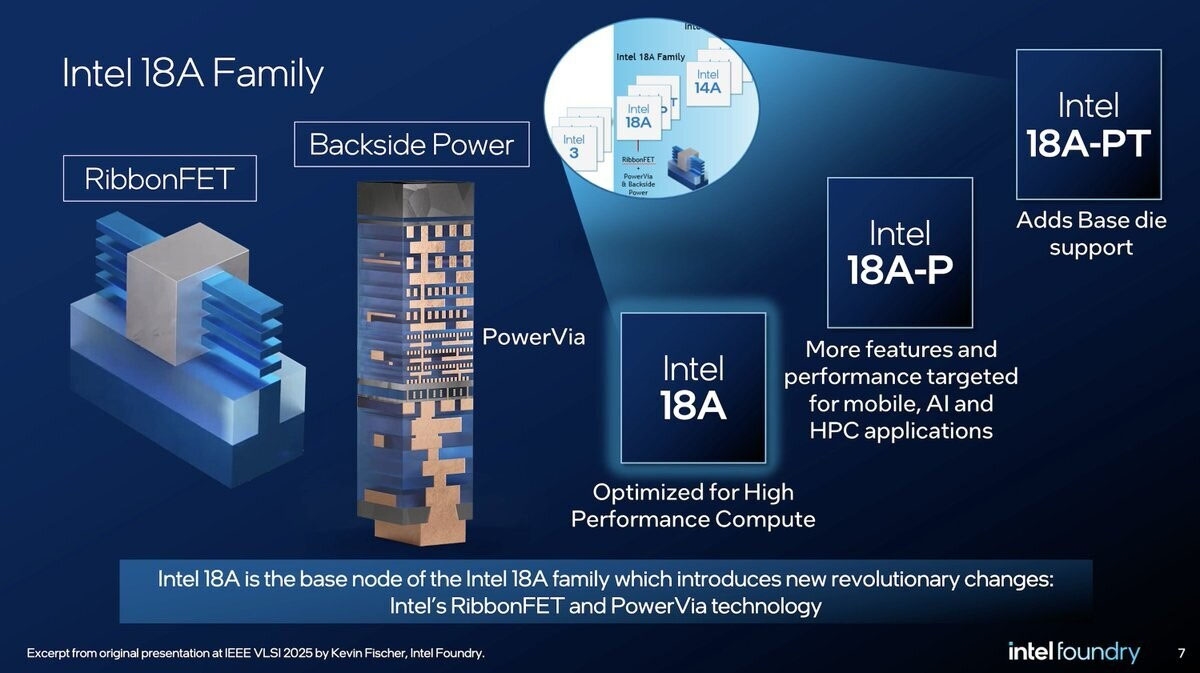
Intel has delivered version 1.0 of the 18A-P PDK process design kit to potential customers to support their chip verification testing. The process remains based on the RibbonFET gate-all-around transistor architecture and PowerVia back-side power delivery technology, and is a performance-enhanced version of the 18A platform.
According to TrendForce, Apple is evaluating the adoption of the 18A-P process for the production of M-series chips, while Google is considering leveraging Intel’s EMIB advanced packaging technology to advance the TPU v8e project, with related products potentially landing as early as 2027.