How OpenAI’s $500 Billion Data Center Project “Stargate” Changed Course
OpenAI’s ambitious “Stargate” plan, initially a $500 billion project to secure computing power, is undergoing adjustments, with some projects even being abandoned. However, the company’s willingness to do whatever it takes to acquire computing power has given it an edge in the artificial intelligence infrastructure race.
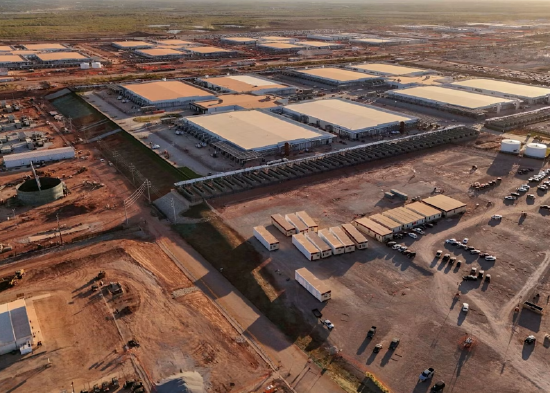
In recent weeks, the group has halted data center plans in the UK and Norway, abandoned an expansion of its flagship site in Abilene, Texas, and seen several executives associated with the “Stargate” project leave for rival Meta.
The “Stargate” plan was initially announced in early 2025 by Donald Trump as a $500 billion joint venture between OpenAI, Oracle, Abu Dhabi fund MGX, and SoftBank of Japan, aimed at building and operating dedicated data centers for OpenAI. The initial intention was to pool funds to address the high costs and complex construction of AI infrastructure.
This vision has quickly given way to a more flexible model: OpenAI is increasingly relying on third-party providers, preferring to lease computing power rather than build and own facilities.
“I don’t even know what ‘Stargate’ means anymore,” said one person involved in the early stages of data center construction. “I think the term is completely outdated.”
This constantly evolving strategy reflects OpenAI’s overall approach. The company makes multiple bets, from core technology to partnerships, and then abandons all non-optimal choices. A person close to the company said this approach is largely due to CEO Sam Altman’s “venture capital mindset.”
Those familiar with the changes to “Stargate” say that OpenAI has effectively abandoned the joint venture model, instead seeking a series of large bilateral deals. But OpenAI executives say the core guiding principle remains “building more compute.”
Oracle has played the most central role, having agreed last year to provide 4.5 gigawatts of computing power to OpenAI under a five-year, $300 billion deal.
The company has also partnered with AMD, Broadcom, Nvidia, CoreWeave, and Cerebras, with commitments once exceeding $1 trillion, although some commitments have since been scaled back.
There are still questions about whether it can afford the massive infrastructure spending. On Tuesday, reports surfaced that OpenAI failed to meet internal revenue and user growth targets, causing the stock prices of SoftBank, Oracle, and CoreWeave, among other associated companies, to fall. OpenAI responded that its business is “running full steam ahead.”
By shelving or modifying the “Stargate” plan, OpenAI has cut costs. But this practice of renegotiating or abandoning projects at a moment’s notice has made partners uneasy and raised questions about OpenAI’s reliability as a counterparty.
When the plan was launched, OpenAI faced two challenges: complex supply chains and caution from lenders towards a startup with no credit rating and continued losses, so it planned to build data centers itself under the name “Stargate.”
The joint venture – pooling funds from blue-chip partners and securing endorsement from the US President – was intended to solve both problems at once.
Since then, a surge in demand for AI tools has prompted chip, cloud, and infrastructure companies to take action, and investor skepticism has eased.
“We created enough demand in the market that others stepped up, so we marginalized the plan to build data centers ourselves,” said one person involved in the “Stargate” project.
OpenAI said: “‘Stargate’ is an umbrella term for our compute strategy, and we have fully delivered on our commitment: securing compute for OpenAI at an unprecedented scale.
“We have built a broad network of partners across cloud, chips, and infrastructure, and compute is coming online and ahead of schedule. This massive build-out is designed to get powerful AI into the hands of more people, businesses, and developers.”
This month, OpenAI shelved a data center project in northeast England and adjusted another in Narvik, Norway. Both projects had previously been touted as part of “Stargate” and were being developed in partnership with AI cloud computing startup Nscale.
OpenAI blamed strict regulations and high energy costs for calling off the UK project, a move that angered the British government. Kanishka Narayan, the UK’s AI minister, said: “The only thing that has changed since the initial commitment is OpenAI’s funding environment.”
Nscale, based in the UK, had already invested heavily in the expectation of leasing compute to OpenAI. Microsoft has now taken over Nscale’s site in Narvik. OpenAI said it still plans to obtain compute from Norway through its overall partnership with Microsoft, rather than leasing directly from Nscale.
Last month, the AI lab abandoned plans to expand its site in Abilene, Texas, declining to exercise a lease option with developer Crusoe.
One person involved in the “Stargate” project revealed that OpenAI found cheaper options in places like Michigan, because “there’s only so much money in the world, and no matter what Sam (Altman) says, expansion is incredibly expensive.”
Microsoft has taken over the additional compute in Abilene. A person close to Crusoe said Microsoft is a more ideal tenant. “It’s a better outcome, (they have) a higher credit rating.”
A person familiar with Microsoft’s thinking said the decision “helped partners who were disappointed and misled by OpenAI’s actions on projects.”
The person added: “‘Stargate’ has morphed three or four times, I don’t know what it is now. I can’t tell. Maybe it never really existed.”
When the “Stargate” plan launched, the company set a goal of locking in 10 gigawatts of compute (roughly equivalent to 10 nuclear power plants) at a cost of around $500 billion by the late 2020s.
Today, the company’s goals are higher. It claims to have secured more than 8 gigawatts of compute and expects to spend more than $600 billion by the end of 2030.
This means the consistently loss-making company will spend far more than competitors like Anthropic and Elon Musk’s xAI, approaching the scale of tech giants like Amazon, Google, Microsoft, and Meta, which generate hundreds of billions of dollars in annual profits.
As a major funder of the original joint venture, SoftBank is building its own data centers, but they are not yet operational. A person familiar with the matter said that compute from a project in Ohio could be supplied to OpenAI through a bidding process in the future.
Another person familiar with the thinking of the Japanese investment firm said: “‘Stargate’ hasn’t disappeared, it’s evolved, and now people can basically define what ‘Stargate’ is. In a way, any project involving SoftBank or Oracle can be called ‘Stargate.’”
SoftBank declined to comment.
One person involved in the “Stargate” project said the term lost its meaning when OpenAI’s policy and public relations teams used it as a catch-all for infrastructure construction. They said including the tenancy of a data center in Europe within the “Stargate” umbrella was “always a misrepresentation.”
Despite this, OpenAI’s massive investment in infrastructure could still give it an advantage. Dario Amodei, CEO of Anthropic, has criticized the competitor’s aggressive plans. But facing power constraints that are beginning to limit its ability to meet rapidly growing demand, Amodei also approved billions of dollars in long-term compute spending this month.
If OpenAI can deliver on its massive spending commitments, its moves may prove prescient.
Earlier this month, OpenAI’s chief revenue officer, Dennis Dress, wrote in an internal memo to sales staff: “We saw the exponential growth in compute demand earlier and moved faster, and that’s now creating a real structural advantage.”