Miniature Homemade Solar Car Finds a Realistic "Sweet Spot"
While mass-producing solar-powered cars remains challenging, a creator has demonstrated a more viable path by shrinking the vehicle's size and reusing electric bicycle technology. Despite improvements in solar panel price and efficiency, generating enough energy for long-distance travel on a standard-sized car remains difficult, with energy density being the core bottleneck. In this context, a miniature two-seater solar car built using electric bicycle components offers a compromise.
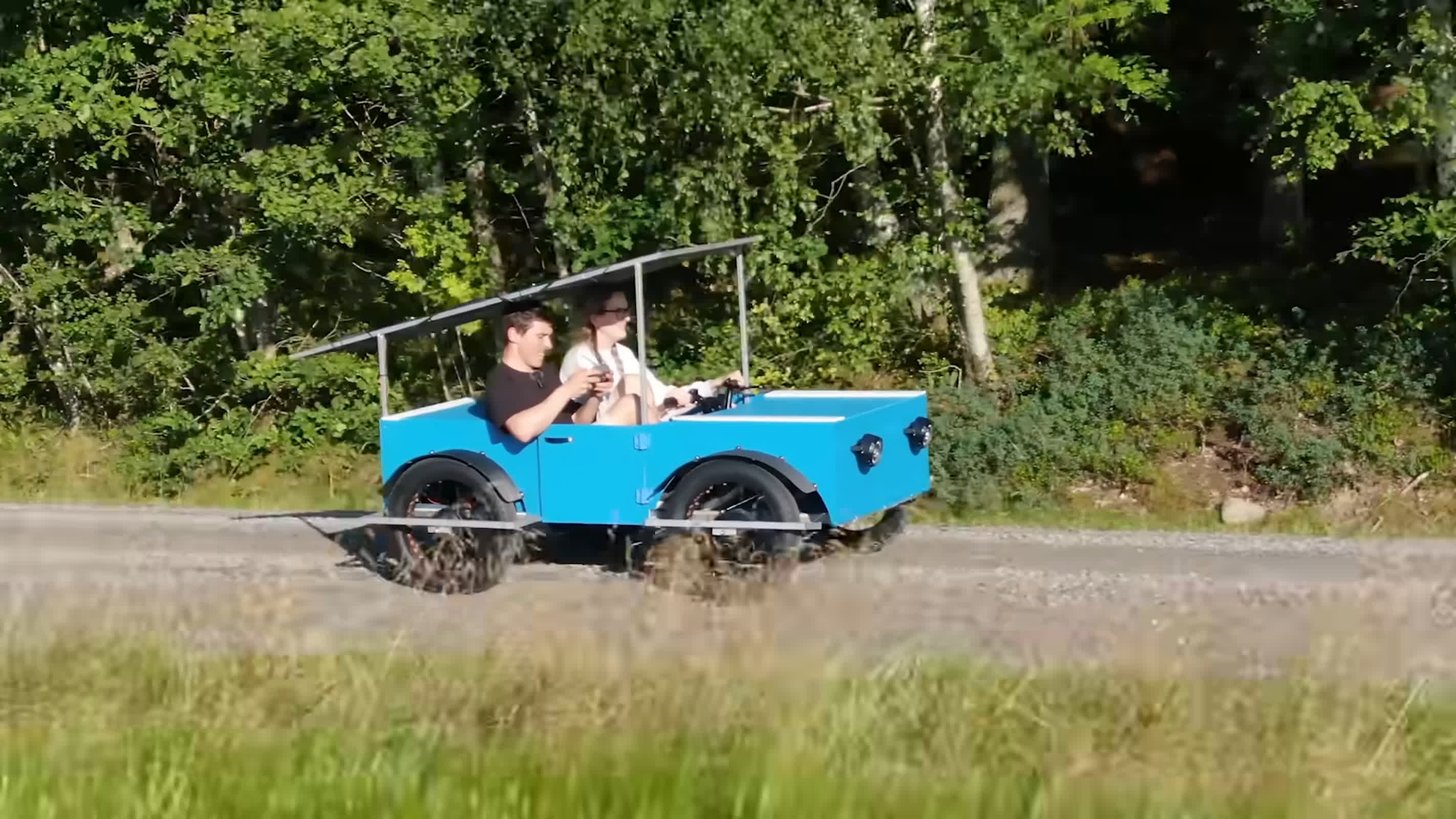
Earlier this year, YouTuber Simon Sörensen assembled a compact two-seater solar car using parts from two electric bicycles. Instead of developing an entire automotive platform from scratch, he chose to directly reuse existing electric bicycle transmission systems and build a lightweight body around these components, significantly reducing costs and structural complexity. This approach also facilitates improved overall energy efficiency with limited solar input.
The car's transmission system is its most striking feature. Each wheel is equipped with an independent in-wheel motor, creating a four-wheel independent drive structure that delivers power directly to the wheels, eliminating the need for a traditional central motor and complex transmission mechanism. Sörensen stated in an interview with SupercarBlondie, “The coolest thing about this setup is that I used 1000W hub motors on each wheel.” Thanks to this layout, the vehicle can switch between front-wheel drive, rear-wheel drive, and all-wheel drive modes based on control strategies.
The frame is welded from steel tubing, offering a simple, rigid structure capable of supporting the weight of the battery and solar panels. The steering system employs Ackermann steering geometry to ensure that each wheel maintains a reasonable steering angle relationship during turns. This is particularly crucial given the configuration where each wheel is driven by an independent motor, as differences in torque output between wheels directly affect vehicle handling stability.
The vehicle's power is supplied jointly by solar input and battery storage. Three lightweight solar panels are arranged on the roof, providing a maximum generating capacity of approximately 300 watts under ideal lighting conditions. This electricity is fed into a 48-volt battery, which takes over power supply when solar output is insufficient. Under sufficient sunlight, the vehicle can cruise at a lower speed and minimize battery consumption.
Regarding range, Sörensen estimates that the car can travel approximately 20 miles solely on solar power before needing to rely more on battery storage. The specific range will vary depending on weather, road conditions, and usage. “The car has a range of around 50 kilometers (about 31 miles), but on a sunny day, it might be able to reach 100 kilometers (about 62 miles),” he added. These figures more accurately reflect the auxiliary role of solar panels in extending range rather than completely replacing external charging.
The vehicle's top speed is approximately 30 miles per hour, significantly higher than a typical electric bicycle but lower than traditional road vehicles, placing it closer to the "neighborhood electric vehicle" category. The lower speed means lower energy consumption per unit time, making the contribution of the solar system to the vehicle's energy structure more visible.
This homemade solar car does not fundamentally solve the physical limitations of solar cars in large-scale transportation applications, but it clearly demonstrates the adaptability of the technology on "small and light" platforms. By combining readily available electrical components and moderately sized solar power generation capabilities, this project provides a realistic example of extending the range of electric vehicles without relying entirely on grid charging.