US Stocks Hit Record Highs, Marking Best Monthly Performance Since 2020
Driven by investor bets that the artificial intelligence boom will bring huge profits to US tech giants, US stocks closed at record highs, achieving their best month since 2020. The S&P 500 rose 10% in April, its largest monthly gain since the breakthrough in COVID-19 vaccine development in November 2020. After an initial market sell-off triggered by rising energy prices during the early stages of the Middle East conflict, US stocks have rebounded.
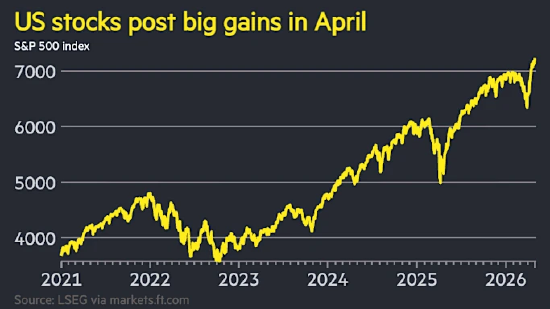
Technology stocks led this round of rebound, with the Nasdaq Composite Index, heavily weighted with technology stocks, soaring 15% in April, marking its best monthly performance since April 2020.
As analysts continue to raise corporate earnings expectations to new highs, investors have flocked back to the US technology stock market. The market is generally optimistic about Silicon Valley's leading companies significantly increasing investment in artificial intelligence infrastructure to support economic growth.
Benefiting from leading growth in its cloud business, Alphabet rose 10% on Thursday, with a cumulative increase of around 34% this month. Chipmaker Intel surged 114% this month on strong earnings, leading the S&P 500 components; storage giants Western Digital, Seagate Technology, and Onsemi also rose sharply.
Mike O'Rourke, an analyst at Jones Trading, said the April surge in the semiconductor sector, in particular, was "completely detached from fundamentals," and that stock investors remained unconcerned "in the face of the standoff in the Strait of Hormuz."
Even with a sharp rise in oil prices, this round of stock market gains proceeded as expected. On Thursday, Brent crude oil prices broke through $125 per barrel, and the average US gasoline retail price climbed to around $4 per gallon.
The volatile performance of some large technology leaders did not hinder the overall market strength. Metaverse platform company plummeted about 9% on Thursday, as it announced a decline in user numbers and further increases in capital expenditures, narrowing its monthly gain to 7%; Microsoft fell 4% on the same day.
This week, the first-quarter earnings reports released by the four major cloud computing giants confirmed the technology industry's strong capital expansion plans. Amazon, Metaverse platform, Microsoft, and Alphabet are expected to invest a record $725 billion in artificial intelligence infrastructure this year, a 77% increase from last year's historical high.
Maria Vetman, head of equity strategy at State Street, said: "The earnings reports of major technology companies all confirm that demand for artificial intelligence, computing power, and chips remains exceptionally strong."
Vetman pointed out that the firm's custody data shows that institutional investors have continued to increase their holdings of US stocks since the outbreak of the Middle East conflict, focusing on technology and energy sectors. She said: "Capital is flowing out of other regions around the world." Bloomberg data also shows that investors poured $125 billion into US stock index funds in April, while similar funds in Europe and Asia experienced net outflows.
"Currently, the market favors sectors with stronger profit margin resilience, and the technology industry is the first choice, there is no better alternative," Vetman said.
Citi raised its rating on US stocks this month, giving an overweight recommendation compared to other global markets. Beata Manthey, the firm's global equity strategy chief, said the technology sector is single-handedly carrying the market's performance.
Charlie McElligott, a Nomura analyst, believes this rally has completely ended the rotation from technology AI leaders to other sectors that lasted from the end of last year to February. He added that technology stocks have once again completely dominated the performance of major index returns.
At the same time, economic data released this week show that although technology stocks are leading the way strongly and diverging from other sectors, the US economy has begun to be affected by regional conflicts.
As the world's largest economy, the US annualized economic growth rate in the first quarter was 2%, lower than the 2.2% forecast by economists surveyed by Bloomberg. The overall inflation rate, closely watched by the Federal Reserve, rose to 3.5% in March, the highest in nearly three years.
Soaring oil and gas prices could push up inflation, and investors have significantly lowered their expectations for the Federal Reserve to cut interest rates this year.
Dan O'Keefe, a portfolio manager at Artisan, said: "The market is largely indifferent to various risk events. Whenever there is turmoil and increased uncertainty, investors will return to assets with higher certainty."
O'Keefe mentioned that while the repricing of interest rate expectations will impact some stock market sectors, the actual impact of interest rate fluctuations on leading technology companies is minimal.