OpenAI Radically Upgrades Codex, Takes Control of Mac – Humans Observe Entire Process with Zero Interaction
OpenAI's agent, Codex, directly challenges ClaudeCowork. Codex, OpenAI’s flagship code generation model powering products like GitHub Copilot, has become an indispensable AI assistant for developers worldwide. This update is significant, as demonstrated by a test video from YouTube creator Mike Russell, showcasing impressive results.
He handed over his Mac completely to OpenAI's latest upgraded Codex, allowing GPT-5.5 to control Adobe Audition to repair audio, use Photoshop to create covers, and then use Adobe Firefly to generate AI videos.
Throughout the entire process, humans had zero interaction.
This isn’t a demo, nor a PPT presentation; it’s a real creator running their entire productivity toolchain completely with AI.
OpenAI co-founder and President Greg Brockman directly stated: “Codex is available to everyone, and can handle all computer tasks!”
Yes, a tool for writing code is suddenly trying to take everyone’s keyboard.
AI influencer 歸藏 (Gui Cang) stated that Codex helped him develop a complete game in an afternoon with just a single sentence.
Most surprisingly, Codex handles materials in a unique way: He provided a package containing thousands of images without specifying a selection method.
Codex automatically compiled the images within each folder into a comprehensive overview, including file names.
This allows you to grasp the overall style of all materials with just one glance, and then directly call up the files you need. This operation is truly astonishing, and he exclaimed that Codex is amazing!
Netizens exclaimed that Codex has finally reached its “Claude Code highlight moment” – a complex, complete Mac application integrating camera, microphone, and screen recording, which it completed in one go.
Users who have used Codex can’t stop!
Codex has changed: From a code assistant to a computer butler.
In the past, everyone’s understanding of Codex was clear – it was a tool for writing code. It could help you complete functions, debug bugs, and generate scripts, serving as a co-pilot for programmers.
This upgrade has completely broken the boundaries.
The most crucial sentence in OpenAI’s official announcement: Codex now supports Slack integration and full integration with the Google Workspace suite. Translated into plain language, this means – it can not only write code, but also read your emails, reply to your Slack messages, and operate your Google Docs and Sheets.
This sentence reveals OpenAI’s ambition: it’s no longer positioning Codex as a developer tool, but as a universal computer control agent.
Just yesterday, Codex suddenly announced a large wave of updates.
It can automatically summarize changes, perform data analysis, and assist in decision-making across Slack, Gmail, and Calendar.
It can organize research materials, create spreadsheets, and presentations.
It can analyze data exports, mark changes, and draft interpretation reports.
It can also compare multiple options based on standards, and track trade-offs.
OpenAI co-founder Greg Brockman, a top hacker who is accustomed to 20 years of black screen command-line terminals and treats code as life, publicly announced: “I have completely fallen in love with the Codex App, it has replaced my 20-year-old terminal.”
Developers understand the significance of this.
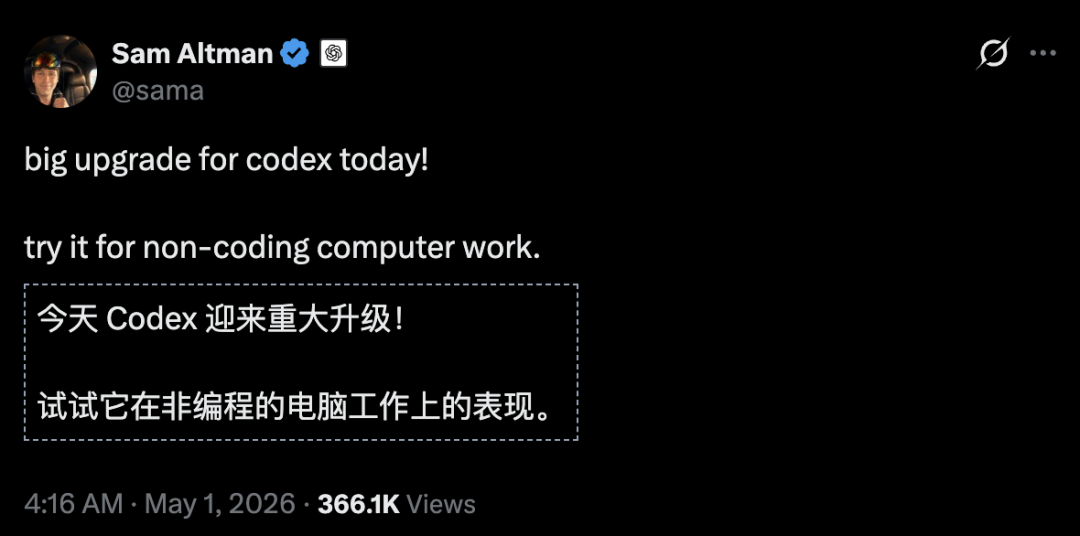
This powerful update prompted Altman to post directly: “Codex is experiencing its ChatGPT moment!”
Following this large wave of updates yesterday, early this morning, Tibo, a core member of OpenAI Codex, posted on X saying “Feeling codexy today,” hinting that Codex will soon usher in another epic update.
This post instantly ignited the developer community!
Sure enough, before long, OpenAI began releasing new cases.
Using Codex to handle daily work has never been so easy. You can choose your role, connect the applications you use every day, and try the recommended prompts.
Whether it’s research and planning, or documents, presentations, spreadsheets, etc., Codex can provide assistance.
Codex will recommend useful plugins based on your role and guide you to connect various applications, such as SlackHQ, GoogleWorkspace, Microsoft365, and so on.
It’s like your personal assistant, able to summarize data from different applications and documents, plan the next steps, draft work, organize research, or create project plans.
You can see at a glance what’s happening, including task progress, files and tools used, and what to do next.
From draft to completion, you can review the content as it gradually takes shape within Codex. Open files, suggest modifications, and continuously optimize and adjust within the same conversation thread.
A developer influencer stated that Codex and Claude Code are very different.
If the limit is about to end, then you can execute a long-running task, and even if the limit has been reached, Codex will continue to execute the task until it is completed.
This post was directly forwarded by Altman.
Tibo also stated that OpenAI chose the former between a good user experience and optimizing profitability.
Even OpenAI released an official blog guide specifically introducing how to use Codex in daily work.
Claude Code’s top fan turns to Codex, Altman applauds.
On the same day as Codex’s upgrade, another scene unfolded.
On X, a user expressed their feelings: “Claude Code’s generation quality has noticeably declined in the past three weeks, with a sharp drop in accuracy, so I spend 90% of my time using Codex and am very satisfied.”
Altman quickly appeared and responded with a Star Wars reference: “Welcome to the light side!”
Sure enough, more developers came forward to say that they really don’t like using Claude because it’s clumsy, the user interface is always wrong, and there are many bugs.
This time, the developers voted with their feet.
Codex’s test is too crazy!
Codex App developer Andrew Ambrosino bluntly stated: “Codex gets everything done!”
This update allows Codex to automatically adapt the dynamic UI for the current task, providing a better experience:
Slides and tables experience are improved.
Supports direct annotation in browsers, artifacts, and code.
Easier to get started.
Overall design is more streamlined.
Overall performance is improved.
A device toolbar has also been added to the Codex app’s browser, making it more convenient to build and test responsive applications –
Browser speed (approximately 30% faster in subjective testing).
However, “everyone is good is truly good,” and the first wave of network-wide testing has arrived. Let’s take a look.
Taking control of the entire Mac, humans observe the entire process with zero interaction.
Mike Russell’s test is the most intuitive proof of this upgrade.
He gave Codex three tasks:
Task 1: Audio repair. A recording had obvious background noise and sibilance issues. Codex automatically opened Adobe Audition, identified the noise characteristics, applied noise reduction filtering, adjusted EQ parameters, and exported the finished product.
Russell listened back afterwards and commented: “Professional-level repair, cleaner than I manually adjusted it.”
Task 2: Podcast cover design. Codex opened Photoshop, automatically selected a color scheme based on the podcast topic, arranged the title text, adjusted layer blending modes, and output a cover image that could be uploaded directly.
Task 3: AI video generation. Codex called Adobe Firefly, generated video clips based on text descriptions, automatically spliced them together, and added transitions.
Three tasks, spanning three Adobe professional software programs, completed automatically.
Russell repeatedly emphasized one detail in the video: he didn’t touch the mouse or keyboard at all, and didn’t even switch windows. Codex completed all software switching and coordination at the operating system level.
“This isn’t AI helping me work,” Russell said, “this is AI working for me.”
Codex’s upgrade doesn’t target programmers, but everyone who relies on computers to work.
When AI can control your entire computer, the skill of “knowing how to use software” itself is becoming devalued.
Of course, Russell’s test wasn’t perfect.
The video material generated by Firefly had a few frames with obvious image jitter, which Codex didn’t automatically identify and correct. The text layout of the Photoshop cover had inconsistent font sizes on the first attempt, and Codex discovered it itself and made a second adjustment before passing.
Russell’s summary was very practical: “It’s not 100 points, probably 85 to 90 points. But the problem is – it took 8 minutes to reach this level, and it would take me 2 hours to do it myself.”
85 points multiplied by 8 minutes, versus 100 points multiplied by 2 hours. In most scenarios, the former wins.
Codex helps you shoot product photos with zero cost and unlimited times.
Netizen Matthew Berman directly introduced how to use Codex to shoot products an unlimited number of times, turning a network connection into a complete e-commerce photo library:
Previously: A set of e-commerce product photos cost $5,000 - $25,000 and took 4 weeks.
Now: Enter a URL, get results in 10 minutes, at a cost of $0.
He encapsulated the entire system into a “Brand Shoot Kit.”
How does it turn a web link into a complete e-commerce photography library?
It only requires the following 7 Agent (intelligent agent) skills:
Will the human keyboard finally be eliminated?
In the past, fully manual UI debugging was often very exhausting.
Every time you had to check point by point whether the AI had broken other unrelated parts, this pressure was silent.
But if we can hand over the runtime UI behavior testing to AI, the burden on the human side can be reasonably reduced.
Now, Codex has finally brought hope!
Obviously, Codex is already able to use the mouse to check one by one whether the UI interface or behavior is normal – the entire process is fully automated.
Netizens exclaimed: “This feels like ‘the things people have been waiting for AI to do’ have finally arrived.” “I feel like we are gradually approaching the critical point of the next major shift.”
In the video’s conclusion, Russell said: “When AI can control your entire computer, the skill of ‘knowing how to use software’ itself is becoming devalued.”
This time, Codex didn’t target programmers, after all, programmers are already used to AI writing code.
This time it targeted everyone who relies on computers to work – those who make PPTs, write emails, edit audio, retouch photos, and create reports.
Previously, the logic was that people learn to use tools, and tools amplify people’s abilities. Now the logic is starting to change: AI learns to use tools, and people only need to make their needs clear.
It can be said that Codex isn’t upgrading features, it’s redefining “using a computer” itself.
In Russell’s 45-minute test, everything that happened on that Mac – the mouse moving on its own, the software switching on its own, the audio rendering on its own – this scene will likely become the most iconic image of 2026.
Previously, humans used the mouse to call software, now AI uses APIs to call software.
What’s next? Unimaginable.