Labor Shortage Intensifies: Japan Airlines Launches Humanoid Robot Pilot at Tokyo Haneda Airport
Faced with a prolonged labor shortage, Japan Airlines has begun testing humanoid robots for airport ground operations at Tokyo Haneda Airport. A joint statement released on Monday announced that JAL will collaborate with GMO AI & Robotics to pilot the use of humanoid robots for tasks such as baggage handling and cabin cleaning starting in May.
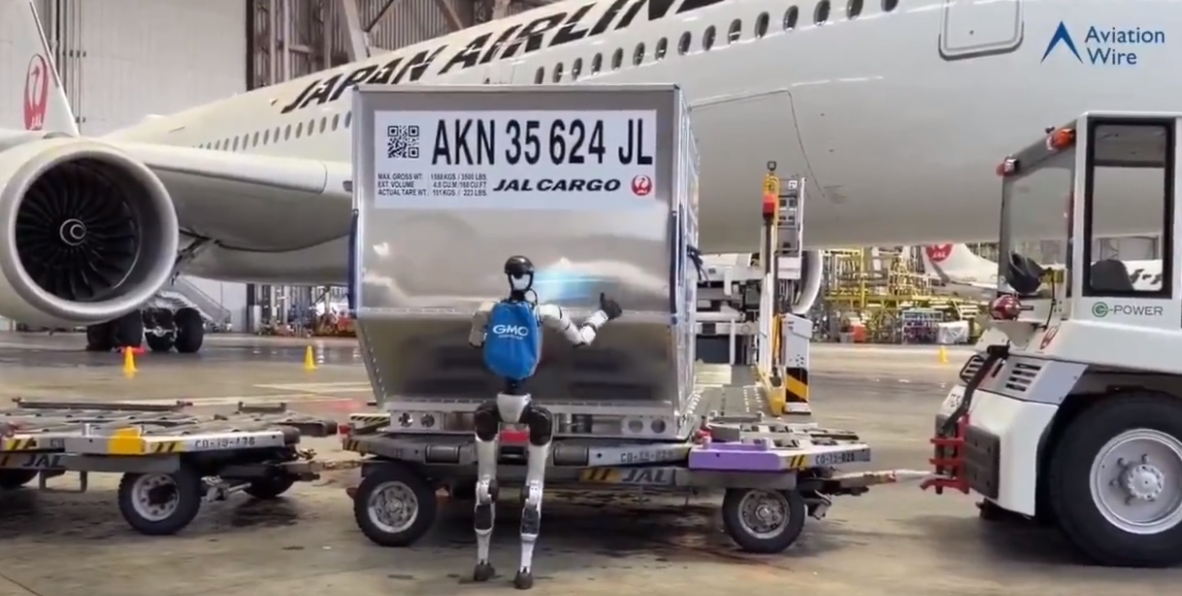
Japan's aging population and shrinking workforce, coupled with continued growth in tourism demand, have exacerbated the labor shortage in the aviation industry, leading to this pilot program.
JAL stated that humanoid robots will be gradually deployed at Haneda Airport, with the pilot program lasting two years.
A technical demonstration video showcased humanoid robots developed by Chinese company Unitree Technology performing actions such as pushing cargo onto a conveyor belt, waving to onlookers, and shaking hands with staff.
Japan Airlines stock rose approximately 2.97% on the first trading day of May, an increase of 73 yen; however, it has still accumulated a decline of about 13% overall this year.
Unitree Technology, a leading Chinese robotics company, gained significant attention when its flagship H1 humanoid robot performed a Kung Fu demonstration at the 2026 CCTV Spring Festival Gala.
It remains uncertain whether Unitree Technology is directly involved in the Haneda Airport pilot program or is simply included on a list for comprehensive evaluation of commercial robot technologies. In response to an inquiry from CNBC, JAL stated that relevant feasibility studies and risk assessments are still underway.
Unitree Technology has not yet responded to CNBC’s request for comment.
Addressing Demographic Challenges
Analysts point out that major cities like Tokyo are facing demographic issues such as rapid aging and declining birth rates, which are driving increased demand for humanoid robots.
Barclays stated in a January report: “Aging populations, labor shortages, and shifts in worker employment preferences are opening up application space for humanoid robots, which can take on necessary but undesirable jobs in manufacturing, logistics, agriculture, healthcare, and the hospitality industry.”
OECD Employment Outlook data shows that Japan’s working-age population is expected to decrease by 31% from 2023 to 2060. Counterpoint Research Director Mark Einstein believes that the participation of humanoid robots in the Japanese labor market will continue to increase.
Japanese Prime Minister Takichi Saito’s political support base leans towards tightening immigration policies, and the industry expects the Japanese government to strongly support and promote the practical application of humanoid robots.
Japan’s Ministry of Economy, Trade and Industry issued guidelines on robot and AI application in March, aiming to address labor shortages caused by a declining birthrate and aging population.
Japan National Tourism Organization data shows that the number of international inbound tourists increased by 3.5% year-on-year in March, further increasing the pressure on airport operations personnel.
Many Obstacles Remain to Implementation
Einstein stated that humanoid robots have made significant progress in joint flexibility and AI algorithms in recent years, and can now complete tasks that were completely impossible a few years ago.
Barclays refers to physical robot technology as the next frontier in AI development, with companies striving to deeply integrate physical automation with AI. The firm’s February report estimated that the current physical AI industry is valued at only $2-3 billion, but is expected to surge to $1.4 trillion by 2035.
Physical AI refers to systems that integrate artificial intelligence with physical machines, capable of performing physical tasks in the real world, covering areas such as humanoid robots and autonomous driving.
In China, companies such as Unitree Technology, Intelligent Robotics, and Galbot are accelerating the development of cost-effective humanoid robots and preparing to raise funds through IPOs to expand production capacity and meet growing market demand.
Unitree Technology, headquartered in Hangzhou, was the first to receive IPO approval in March, with plans to raise approximately 4.2 billion yuan (equivalent to $614 million), according to documents disclosed by the Shanghai Stock Exchange.
Despite rapid technological iteration, it remains to be seen whether humanoid robots can completely solve Japan’s long-term labor shortage.
Analysts previously told CNBC that the flexibility of existing robots in fine manipulation and precise movements is still lacking.
Einstein added that the programming logic and autonomous reasoning technology of humanoid robots are still immature, and they still require human intervention and control after deployment.
He frankly stated: “The intelligence level of these robots is still limited at this stage.”
However, looking at industry R&D progress, Counterpoint estimates that the large-scale commercialization of humanoid robots is expected within five years.
Editor: Guo Mingyu