Musk Caught in Defensive Justification Over OpenAI Funding Commitments
During his testimony on April 29th, Elon Musk appeared impatient as he was questioned by OpenAI's lawyer about whether he had reneged on his early funding commitments to the startup. He expressed frustration, claiming the questioning was unfair and misleading. The case centers around Musk's allegation that OpenAI abandoned its altruistic mission in favor of profit.
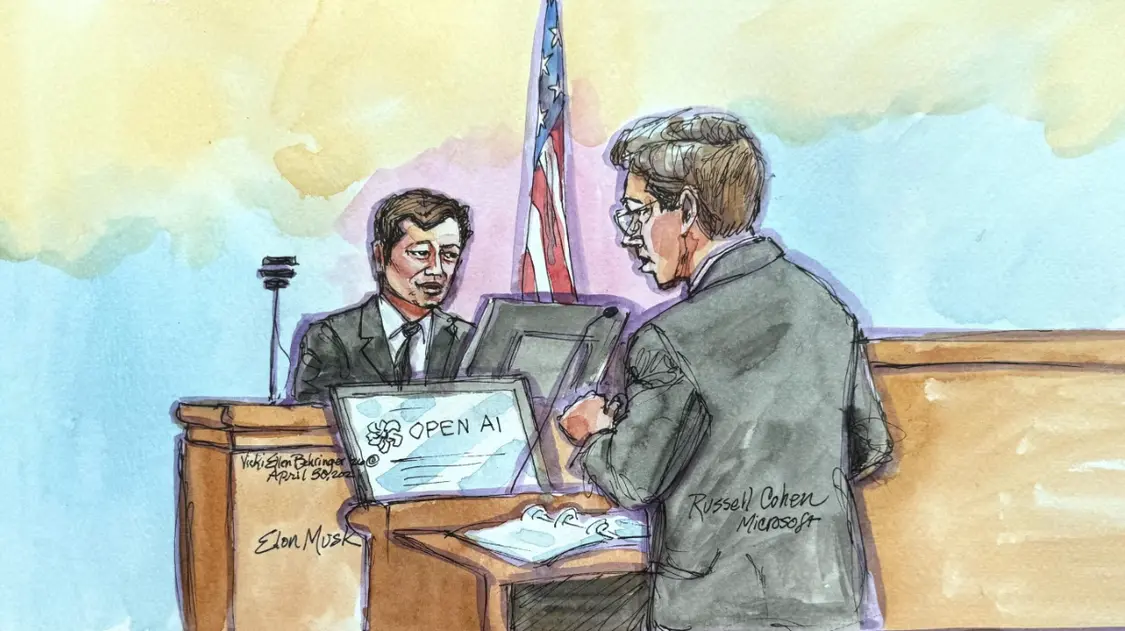
In the highly anticipated trial, Musk entered his second day of testimony. The case revolves around his accusations that OpenAI deviated from its benevolent mission to pursue profit. In court, the world's richest man found himself on the defensive regarding the extent of his actual financial support for OpenAI in its early stages.
Musk engaged in heated arguments with OpenAI attorney William Savitt over the precision of the questions, repeatedly stating that they were “unfair” and “misleading.”
Savitt repeatedly posed what he called “simple” yes or no questions to Musk, but Musk argued that such questions could not be answered so simply.
“Your questions aren’t simple at all,” Musk stated in court, “They are essentially designed to trap me.”
Musk filed a lawsuit in 2024, alleging that OpenAI CEO Sam Altman and President Greg Brockman, with the help of billions of dollars from Microsoft, transformed the company into a for-profit entity, taking the opportunity to enrich themselves.
OpenAI and Altman countersued Musk for malicious harassment, claiming that the true purpose of Musk’s lawsuit was to suppress a competitor and pave the way for his 2023 co-founded AI startup, xAI.
Savitt pressed Musk on the total amount of his actual initial funding to OpenAI. Musk revealed that he had previously donated quarterly to OpenAI and paid rent for its office space until he “lost confidence” in the company’s management.
Musk co-founded the non-profit with Altman, Brockman, and Ilya Sutskever, but differing accounts have been given regarding the scale of Musk’s financial support.
When OpenAI was announced in 2015, the non-profit stated that Musk had pledged up to $1 billion to support its mission of developing AI “for the benefit of humanity.” Musk stated on social platform X in 2023 that he had actually donated $100 million.
“Ultimately, you never put $1 billion into OpenAI, did you?” Savitt asked Musk.
Musk responded that he had begun to doubt OpenAI’s direction around 2017 and gradually lost trust in the founding team.
Savitt interrupted him. “My question is simple,” he said, repeating the question.
U.S. District Judge Yvonne Gonzalez Rogers intervened in their dispute, asking Musk to directly answer Savitt’s question. Musk then requested that the question be repeated.
“My question is: your actual investment in OpenAI was far less than $1 billion, isn’t it?” Savitt said.
“Strictly in terms of cash amount, I invested $38 million,” Musk replied.
The two had previously clashed in court. Savitt is one of the top corporate litigators in the United States, and he represented Twitter in its lawsuit against Musk when he attempted to withdraw from the $44 billion acquisition of the platform in 2022. The case was ultimately settled before trial.
This Oakland trial is crucial for OpenAI, even concerning its survival. Musk is seeking $134 billion in damages, the removal of Altman and Brockman from their management positions, and the revocation of OpenAI’s 2023 for-profit conversion.
To date, much of Musk’s testimony has focused on his disagreements with OpenAI’s management. At the time, they were exploring strategies to raise enough funds to compete with Google under Alphabet and other for-profit AI pioneers.
In 2017, Musk and other co-founders discussed forming a for-profit subsidiary to fund AI research. They proposed that Musk hold a majority stake in the subsidiary and have almost absolute operational control.
Under the initial plan, the board would have 12 seats, with Musk appointing 4 and Altman, Brockman, and Sutskever each holding 1. Musk told the jury that his majority stake was originally intended to be quickly diluted as more investors joined.
However, Musk admitted that the “last straw” in the breakdown of their relationship was that other co-founders appeared to oppose this proposal and expressed concerns about it, and the plan ultimately failed to materialize.
“They reneged on a prior agreement,” Musk said, “I found that practice hypocritical, they really wanted to create a for-profit company and keep as much equity as possible in their own hands.”
Savitt presented emails from 2017 between Musk, Sutskever, Brockman, and others to the jury, detailing discussions about the proposed partnership. In the emails, Musk proposed adjusting the development path to adapt to commercial needs.
In the same email exchange, Musk also offered to give Tesla cars for free to Sutskever and other OpenAI employees.
Musk left the OpenAI board in 2018 and founded the for-profit AI company xAI five years later. xAI was recently acquired by SpaceX, which is moving towards an initial public offering.
Meanwhile, OpenAI is approaching a valuation of nearly $1 trillion and is also preparing for an IPO.
Musk told the jury that he initially established OpenAI as a non-profit because he was concerned about the safety of artificial intelligence and wanted to ensure that the future of the technology would not be completely controlled by companies like Google.
During the April 29th trial, Savitt asked Musk if he believed that a shift to a for-profit model would create safety risks for AI companies. Musk said he believed that “it would indeed create some safety risks.”
“Does your founded xAI also have these safety risks?” Savitt pressed.
“Yes,” Musk replied.
Throughout his testimony, Musk repeatedly emphasized that he does not oppose the creation of for-profit AI companies, but strongly opposes turning a non-profit into a for-profit entity.
“It’s like wanting to have your cake and eat it too, getting the best of both worlds,” Musk said.
Savitt also asked a series of questions about potential conflicts of interest between Musk’s role on the OpenAI board and his investments in Tesla and Neuralink (both companies heavily invested in AI).
The attorney pointed out that despite his fiduciary duty to OpenAI, Musk secretly poached top research talent from the non-profit in 2017, attempting to recruit them to his other companies.
Savitt stated that Musk had recruited OpenAI scientist Andrej Karpathy to Tesla and presented an email from Musk to a Neuralink executive stating that he had “no objections” to Neuralink recruiting OpenAI talent.
“I believe in a free world,” Musk responded, “People should be able to choose where they want to work.”