Seagate Bets on Increased Hard Drive Density, 5TB Single Platter Coming Next Year
With the rising prices and shortages of memory chips, traditional HDDs have also experienced a surge in demand. AI data centers have extremely high requirements for storage capacity, and competition in this market is less intense than in the memory market, mainly between Seagate and Western Digital. Seagate's recent financial report was also impressive, with revenue of $3.11 billion, a 44% year-on-year increase, a gross profit margin of 46.5%, and a net profit of $748 million, a 120% year-on-year increase.
Seagate shipped 199EB of hard drive capacity last quarter, a 39% year-on-year increase, with 88% of shipments going to data centers, generating 80% of revenue (it seems earning money this way isn't as profitable as consumer products).
The main problem facing hard drive manufacturers is the high demand for HDDs from customers, but Seagate and Western Digital also have some disagreements on technology in this area. Western Digital hopes to increase the number of hard drive platters from the current 10 and 12 to 14, and also hopes to launch high-bandwidth hard drives using dual actuator arms to further improve hard drive performance.
Seagate's focus is different. They do not agree with continuing to stack platter counts or developing multi-actuator arm hard drives, although Seagate also has this technology. They previously launched MACH.2 dual actuator arm hard drives.
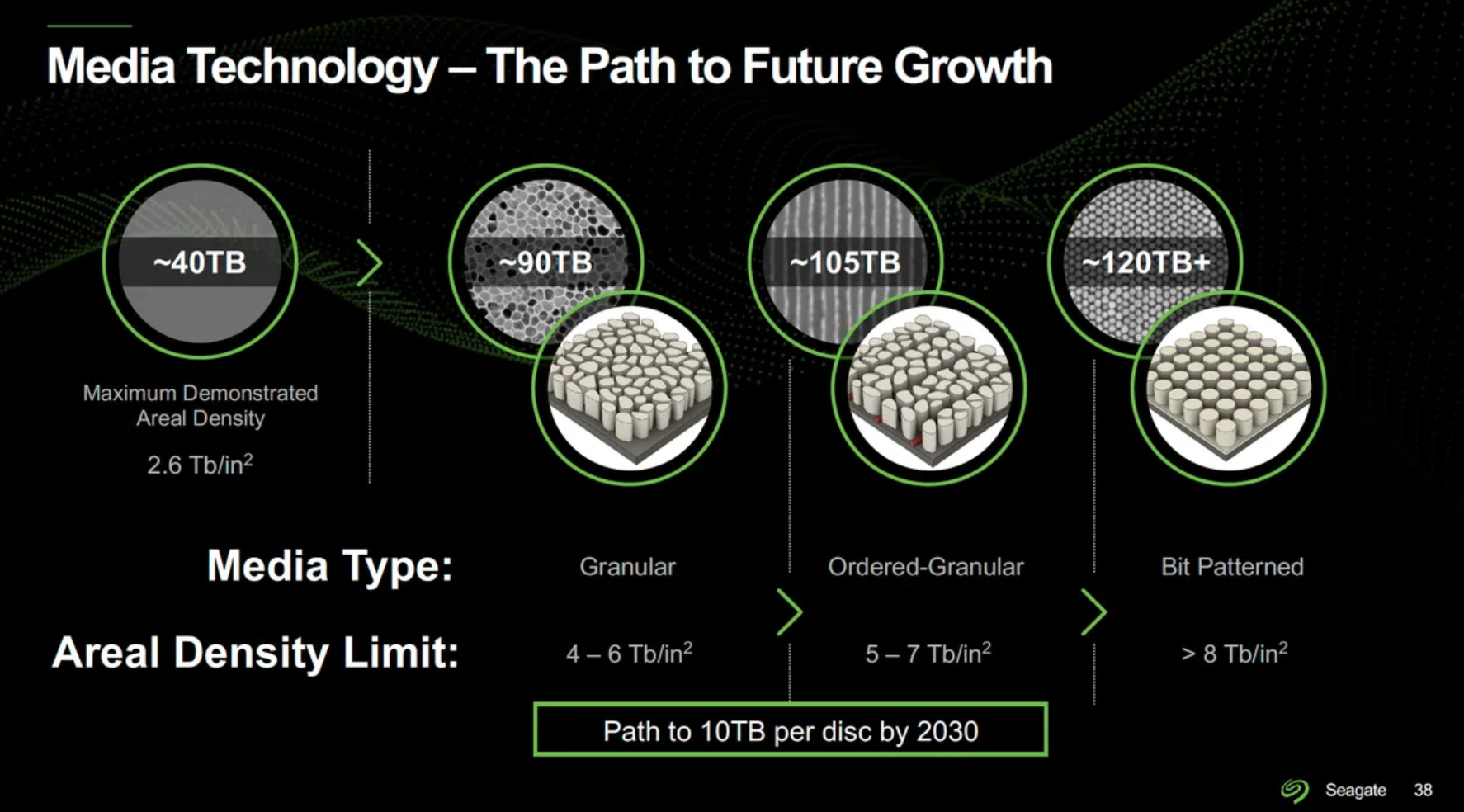
Seagate is currently more optimistic about increasing hard drive density, which means increasing the density of a single platter using technologies such as HAMR. They have already launched three generations of HAMR technology. The current second-generation technology, Mozaic 4+, can achieve a capacity of 4.4TB per platter, creating a 44TB hard drive with 10 platters, and will become the mainstay of HAMR shipments by the end of this year.
The next generation, Mozaic 5, can achieve a capacity of 5TB per platter, 50TB with 10 platters, and is expected to begin certification in late 2027.
Of course, this will not be the end of HAMR. Seagate and Western Digital announced a roadmap for 100TB hard drives many years ago, originally planned for 2030, but HAMR technology has been delayed in recent years. Seagate's latest plan is to achieve 10TB per platter in 2033 and commercially ship 100TB hard drives in 2033.