ChatGPT Directly Connects to OpenClaw, Ultraman Wishes You "Happy Shrimp Catching"
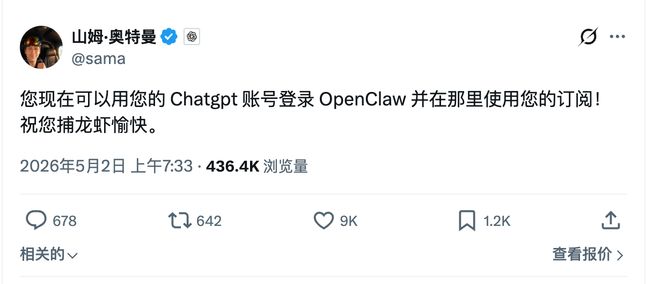
Ultraman announced on X that users can now log in to OpenClaw with their ChatGPT accounts and use their subscriptions there, wishing them a happy lobster catch. Previously, using GPT-4/5 models on OpenClaw typically required binding an OpenAI API Key; now, users can directly use their ChatGPT subscriptions (Plus/Pro) and utilize their subscription quota within OpenClaw.
For developers, especially those who "raise shrimp" (referring to running automated tasks), the main benefits beyond simplicity and convenience are lower overall token costs.
Previously, running a task like "24/7 email monitoring and response" via API could generate hundreds of dollars in bills each month. Now, the vast majority of ChatGPT Plus or Pro subscribers no longer need to purchase large amounts of API tokens separately; they can simply use their existing subscriptions to call the same level of GPT models within OpenClaw, including GPT-5.5’s Terminal-Bench 2.0 (command-line workflow understanding) and GDPval (knowledge work index) – core agent model capabilities.
OpenClaw was founded at the end of 2025 by Peter Steinberger, a well-known independent developer, and is an open-source AI agent project focused on "completing various tasks." It can connect to various mainstream large models and allows AI to take over users' daily tasks – handling email, writing code, booking flights, operating hardware, and even performing banking interface operations – through instant messaging applications like WeChat groups, Slack, and iMessage, or micro-machine instructions.
Interestingly, in early April of this year, Anthropic (A company), OpenAI’s biggest competitor and founded by former OpenAI members, announced a strategy opposite to OpenAI’s: banning OpenClaw. Starting April 4, 2026, subscribers will no longer be able to access its large models through third-party integration tools like OpenClaw using their Claude subscription quota. If users want to continue using Claude with OpenClaw, they must use the conventional API pay-as-you-go model and pay new fees separate from their original subscription plan. This move caused considerable trouble for a large group of users who rely on open-source AI agents to complete automated work.
Peter Steinberger, OpenClaw’s founder who has since joined OpenAI, strongly criticized Anthropic’s move at the time: “The timing is too coincidental – they first copied some popular features into their own closed-source integration tools (referring to Anthropic’s own agent products like Claude Cowork), and then they banned open-source projects.”
OpenAI has gained a lot of goodwill from developers with this move. One developer commented under Ultraman’s X post: “Other companies are building high walls, while you are just handing out keys. I like this atmosphere, and wish everyone happy playing.”
The fundamental reason for OpenAI’s sudden openness lies in a change in model thinking. During the recent release of GPT-5.5, the official repeatedly emphasized the model’s highly “agent” characteristics: “Our smartest and most intuitive model to date,” and also “an engine built for real work and agent tasks.” Ultraman has rarely and publicly boasted in multiple evaluations that “based on my experience, it knows what to do.” GPT-5.5 will regain its original market share in the fierce competition with rivals like Claude.
In other words, OpenAI’s models are no longer focused solely on question answering, searching, drawing, or writing copy, but on completing tasks – which is also the direction that leading domestic open-source models like Qianwen and Kimi are striving for. ChatGPT’s support for direct login to OpenClaw also means that in the Agent era, AI subscription services are no longer “users must use my platform,” but “users subscribe to AI and can take it with them”: an AI service system that can integrate everything, drive everything, and blend everything. After users log in with their accounts, they can use their AI subscriptions in any Agent, workflow, or application scenario.
The opposite strategies of OpenAI and Anthropic towards OpenClaw reflect a fundamental shift in the competitive logic of AI giants: OpenAI is gradually moving towards “Open,” embracing open-source co-creation ecosystems, and achieving AI innovation through collective wisdom; Anthropic is moving towards absolute closure, pursuing self-operated ecosystems and closed-loop security.