Berkshire Hathaway's New CEO Hosts First Annual Shareholder Meeting with Reduced Attendance
Berkshire Hathaway's annual shareholder meeting on Saturday lacked the warmth and wit of Warren Buffett's decades-long hosting, yet shareholders still lined up outside the Nebraska arena starting at midnight to hear new CEO Greg Abel lead the event for the first time.
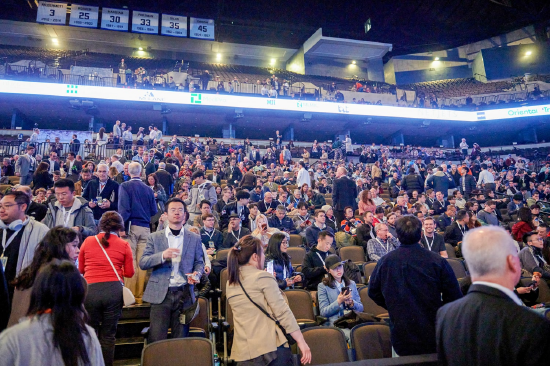
According to reports, attendance was down this year, with the arena only slightly more than half full at the start of the meeting. This contrasts sharply with recent years—when over 40,000 people came to hear 95-year-old Buffett speak, and when Buffett’s longtime partner Charlie Munger also regularly participated before his death in 2023. Buffett stepped down as CEO in January, but remains chairman and offered brief remarks during the meeting.
Much of the discussion focused on Berkshire’s businesses, but current events such as the Iran war and the risks and rewards of artificial intelligence were also mentioned.
Vice Chairman Ajit Jain said Berkshire would be willing to insure ships traveling through the Strait of Hormuz if the price was right and the U.S. Navy provided escorts for vessels.
Jain believes the insurance industry as a whole has sufficient capacity to take on the risk, and that there is indeed demand, as the waterway is a critical passage for global oil supplies. “Simply put, it depends on the price,” Jain said.
Abel said the conflict in the Middle East undoubtedly presents challenges for Berkshire’s businesses, as oil is a foundational input, but he believes management will find ways to cope.
“We’ll quickly pivot to finding the best solutions for our customers,” Abel said.
Honoring Buffett’s Contributions
Saturday’s meeting began with a video tribute to Buffett and the company’s history, featuring footage of shareholders standing and applauding when Buffett unexpectedly announced his retirement last year.
Abel then announced a symbolic gesture: the retirement of jerseys bearing the names of Buffett and Munger, which will be hung from the rafters of the arena.
Buffett again praised Abel, saying he was happy he made the decision to promote him.
“He’s extraordinarily, extraordinarily business savvy,” Buffett said in a live interview during the meeting. Abel grew up in Canada and is in the process of becoming a U.S. citizen. He has been with Berkshire for over 25 years.
Smooth Transition to Abel
Signs of the transition were evident throughout the 200,000-square-foot exhibit hall, where shareholders shopped for products from Berkshire’s companies. At See’s Candies, a commemorative box featured a cartoon image of Abel playing hockey (his favorite sport). At the Pilot Travel Centers booth, photos of Abel and Buffett were plastered on semi-truck windshields, but Abel was in the driver’s seat. This year, shareholders lined up to buy Abel-branded Squishmallow plushies, alongside the latest Buffett and Munger stuffed animals.
“Unfortunately, we miss Warren and Charlie, and the showmanship, but for many, it’s ultimately a business conference, and understanding how the businesses are operating is key,” said Chris Bloomstran, president of Semper Augustus Investment Group and an investor.
But many traveled to Omaha primarily to connect with like-minded value investors, who practice the investment methods employed by Buffett, and to attend investment conferences and seminars scheduled around the Berkshire shareholder meeting.
“That’s really why I come here, the real reason, is to connect with other people,” said Bob Robotti, who runs his own investment firm.
Focus on Berkshire’s Businesses
Abel began the meeting by detailing the operations of Berkshire’s largest businesses. He meticulously explained the performance of Berkshire’s insurance, railroad, and utility companies, and discussed how Berkshire is using artificial intelligence to “solve problems we have within our company.”
But Abel also used a deepfake video of Buffett at the start of the Q&A session to ask questions about Berkshire’s long-term prospects, highlighting some of the challenges and risks posed by artificial intelligence.
“It’s scary,” Buffett said. For example, artificial intelligence could easily create a highly realistic fake image of a national leader of a nuclear-armed country.
Abel repeatedly emphasized that Berkshire’s fundamental approach to trusting CEOs to manage the day-to-day operations of the company will not change, and that he will not feel pressured by the company’s nearly $200 billion in cash to make hasty investments.
“One of Berkshire’s greatest strengths is patience and discipline in capital allocation,” Abel said. “We’re not in a rush to put capital to work in mediocre opportunities.”
Berkshire Hathaway’s Enduring Culture
CEOs of Ice Cream Queen, See’s Candies, Jazwares, and Brooks Running all said that little has changed since Abel’s promotion, except that they now report to NetJets CEO Adam Johnson. Johnson currently oversees 32 retail and service businesses.
“I think it’s the deeply ingrained culture that Warren created, and I believe the transition to Greg will be rooted in the values that Warren built up over 60 years and will continue to hold,” said Dan Sheridan, CEO of Brooks.
Buffett has long said he enjoyed running Berkshire and never considered retirement. But after the shock of his retirement announcement in the final minutes of last year’s annual meeting subsided, company executives quickly agreed that the transition plan was more ideal because Buffett could continue to advise Abel.
“This is the perfect setup right now—to have a leadership transition and to have Warren and Greg continue to work side by side,” said Troy Bard, CEO of DQ, as he watched employees sell Dilly Bars to shareholders.
Striving for Excellence
Abel is known to be more demanding and hands-on than Buffett, but he does so by challenging Berkshire’s CEOs to strengthen their competitive advantages while protecting customer interests. Abel asks tough questions and offers advice that CEOs appreciate, but does not tell them specifically what to do.
With Buffett still serving as Berkshire chairman and largest shareholder, Abel is unlikely to make any major changes.
Robotti said the performance of Berkshire’s businesses is more important to shareholders than the entertainment value of the annual meeting.
“My hope and expectation is that they pick people who can run businesses, not necessarily people who are great at public speaking and showmanship,” Robotti said.
Berkshire reported a more than doubling of first-quarter profit to $10.1 billion, or $7,027 per share of Class A stock, on Saturday morning, driven by investment value gains and improved performance at most of its businesses.
Berkshire’s massive cash pile continued to grow, reaching $397.4 billion at the end of the first quarter.
Most of Berkshire’s diverse businesses reported better operating earnings this year. The insurance segment, including Geico and others, generated underwriting profit of $1.7 billion, up from $1.34 billion last year. BNSF Railway and Berkshire’s utility and manufacturing businesses also saw profit increases.
But Abel acknowledged there is still room for improvement—particularly at BNSF, which lagged behind most other major freight railroads.