Giant Prehistoric Insects Puzzle Scientists: High Oxygen Levels May Not Be the Root Cause
Approximately 300 million years ago, Earth looked vastly different. The continents were joined as the supercontinent Pangaea, with vast coal swamp forests near the equator, significantly higher oxygen levels in the atmosphere, and frequent wildfires. Insects dominated the skies, some species reaching enormous sizes far exceeding their modern counterparts. The prevailing view was that these giant insects existed due to higher atmospheric oxygen levels, but a new study published in *Nature* challenges this classic explanation.
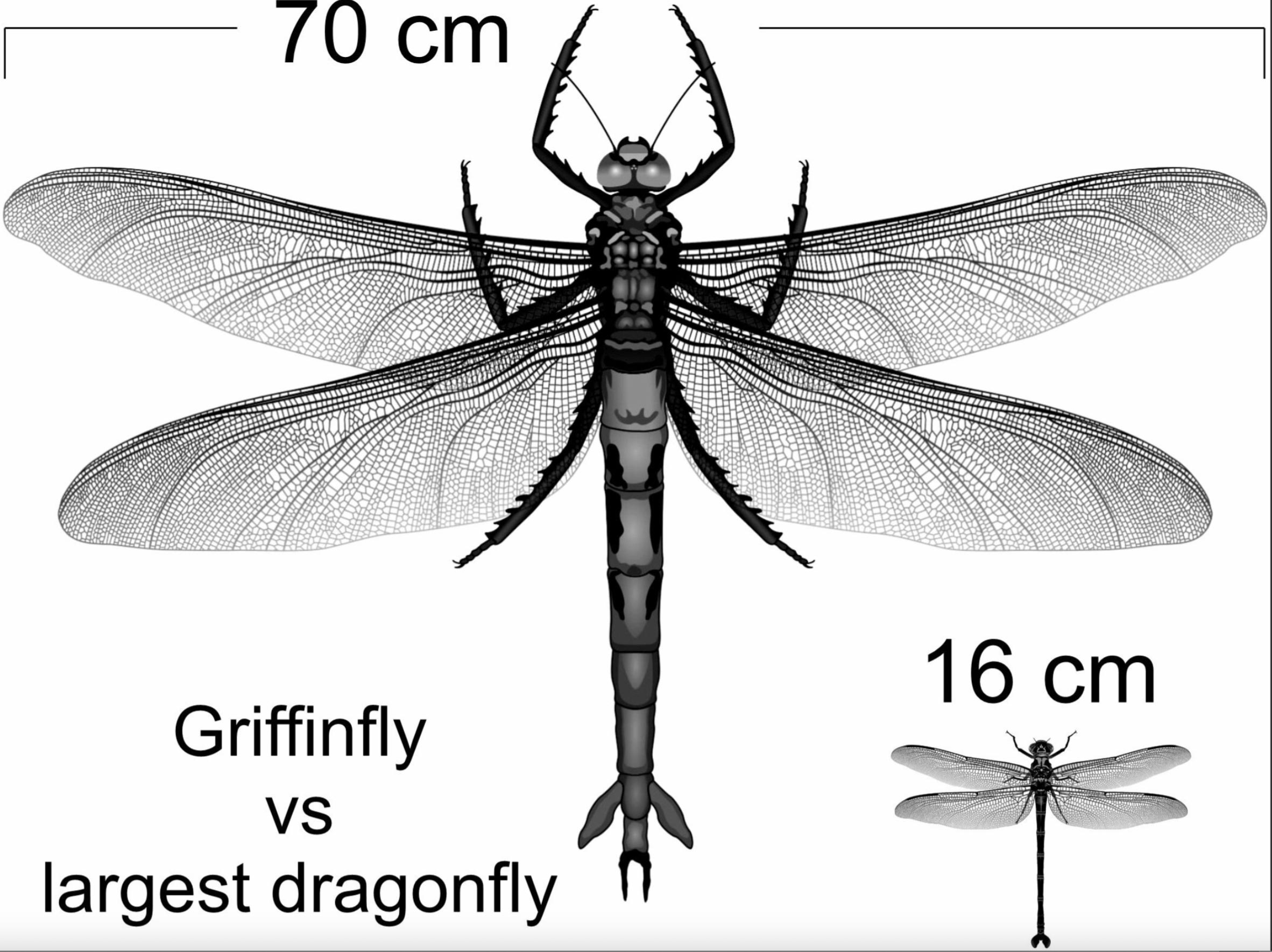
These flying insects included those similar to mayflies, with wingspans reaching approximately 45 centimeters, and giant “protodonates” with wingspans up to 70 centimeters. These giant insects are collectively known as “griffinflies” and were first identified nearly a century ago from well-preserved fossil imprints in Kansas fine-grained sedimentary rocks. For a long time, the mainstream view has been that the existence of these enormous insects was due to the higher oxygen levels in the atmosphere at the time, approximately 45% higher than today, providing the necessary conditions to support giant insects. However, a recent study published in *Nature* challenges this classic explanation of “high oxygen creates giant insects.”
In the 1980s, scientists began developing methods to reconstruct ancient atmospheric composition, and related technologies showed a period of significantly elevated atmospheric oxygen levels approximately 300 million years ago. In 1995, a study published in *Nature* formally linked this high-oxygen period to the existence of giant insects, proposing the hypothesis that “giant insects need more oxygen, and a high-oxygen environment made this size possible.” This view is based on the unique respiratory system of insects: insects do not have lungs but rely on a tracheal system to deliver oxygen—a network of branching airways throughout the body, forming tiny tracheal tubules at the ends, through which oxygen enters flight muscles via diffusion along a concentration gradient. Because diffusion is inefficient over long distances, researchers inferred that it would be difficult to sustain such large flying insects under today’s lower atmospheric oxygen conditions, and therefore giant insects were considered “impossible” in modern atmospheric environments.
The new study presents a very different picture. Led by Edward (Ned) Snelling of the University of Pretoria, the team used high-resolution electron microscopy to systematically analyze the relationship between insect body size and the number of tracheal tubules in flight muscles. They found that in most insect species, the volume proportion of tracheal tubules in flight muscles is usually no more than 1%. This pattern can also be extrapolated to the giant “griffinflies” of 300 million years ago, including individuals with wingspans exceeding 60 centimeters or nearly 2 feet. This means that the oxygen supply structure within the flight muscles does not occupy too much space, and insects are perfectly capable of “evolutionary leeway” to increase the number of tracheal tubules when needed, without incurring severe structural costs.
The research team therefore pointed out that the oxygen supply to insect flight muscles is not fundamentally limited by atmospheric oxygen levels. If atmospheric oxygen content were truly the “hard upper limit” of insect maximum size, then a significant “compensatory increase” in tracheal tubules in flight muscles should be observed in larger insects. Snelling said that while a certain degree of compensation is indeed observed in large insects, it is very limited in the overall structure, far from demonstrating that atmospheric oxygen levels alone determine the upper limit of size.
To further demonstrate this, researchers also compared insects with birds and mammals. In the myocardial tissue of birds and mammals, the proportion of space occupied by capillaries for oxygen transport is approximately ten times that of tracheal tubules in insect flight muscles. Professor Roger Seymour of the University of Adelaide, who participated in the study, pointed out that in comparison, if oxygen transport were a key constraint on insect size, insects could have evolved to “significantly increase” the investment in tracheal tubules like vertebrates to break through the size limit. This comparison further weakens the single causal explanation of “high oxygen determines giant insect size.”
Of course, some scientists caution that atmospheric oxygen levels have not been completely “cleared of suspicion.” Oxygen may still impose limitations on body size in other parts of the insect body, or in the early stages of the oxygen transport chain, so the hypothesis that “oxygen constrains the maximum size of insects” is still difficult to completely overturn. However, the new study clearly shows that at least in the tracheal tubule diffusion stage within flight muscles, oxygen is not a key factor determining whether giant insects can exist. This forces researchers to turn their attention to other possible explanations to answer the open question of “why insects were once so large, and why they eventually disappeared.”
In the current discussion, some alternative factors mentioned include: as evolution progressed, the number of vertebrate predators increased, and predation pressure from birds, reptiles, etc., may have had a profound impact on insect body size evolution; at the same time, the upper limit of the mechanical strength of insect exoskeletons may also become a structural “ceiling” at a certain body size scale, limiting the feasibility of further increasing body size. However, these hypotheses currently lack the widely accepted quantitative evidence like the “high oxygen theory” and still need to be verified by future research. What is certain is that this new analysis of tracheal tubules and flight muscles makes the mystery of the origin of ancient giant insects not diminished but increased, becoming even more elusive.