Players Criticize Western Game Actors, Highlighting Differences in Professionalism Between East and West
A recent comparison of actors involved in Eastern and Western video games has gone viral on social media, sparking widespread attention and heated discussion among global gamers. The post contrasted the responses of the body model for the character Eva in "Sword and Fairy" with the voice actress for the new hero Ramattra in "Overwatch," highlighting their differing attitudes towards their roles and igniting a public outcry.
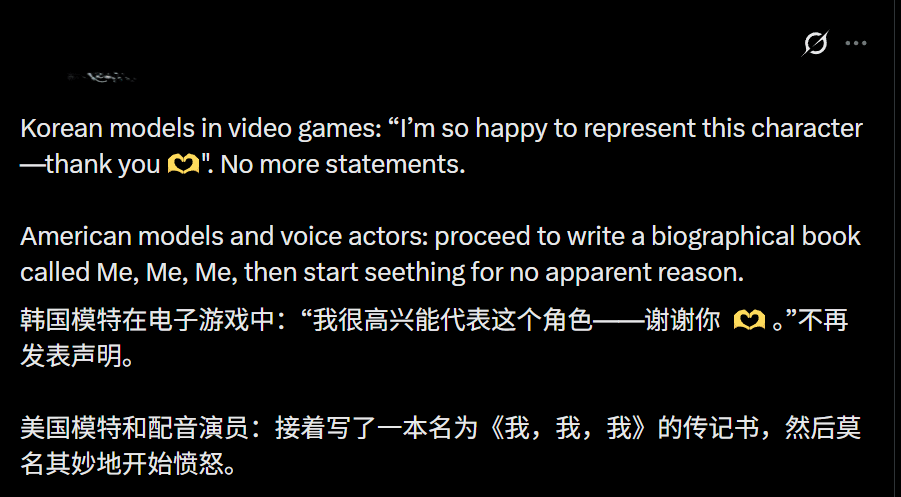
It is reported that the poster explicitly compared the performances of two types of actors: the Korean model (body model for Eva, the protagonist of "Sword and Fairy") simply expressed "I am happy to represent this character – thank you" during game-related activities and made no further statements, demonstrating a concise and humble attitude. In contrast, the American model and voice actress (voice actress for Ramattra in "Overwatch") not only wrote a memoir titled "Me, Me, Me" after working on the game character but also frequently displayed inexplicable anger, creating a stark contrast.
The body model for Eva in "Sword and Fairy" is Shin Jae-eun, a well-known Korean model who provided physical modeling references for the character, whose image closely matches Eva in the game and previously sparked heated discussion due to her cosplay replicating the character. The voice actress for Ramattra in "Overwatch" is Fareeha Andersen, a long-time streamer who lost her voice for a year due to illness and happened to receive the opportunity to voice Ramattra after recovering, and she also publicly supported Blizzard's redesign plan for Ramattra, causing widespread community reaction.
After the comparison was posted, it quickly attracted a large number of players to comment, with different viewpoints clashing fiercely in the comment section. Some players openly expressed their dissatisfaction: "Not LGBTQ+ or just ugly and narcissistic," directly criticizing the performance of some Western game actors.
Other players analyzed the issue from the perspective of the industry environment, believing that the root of the problem was not the Western game developers themselves: "Western game developers are not the problem. They were doing very well before DEI and feminism. The real problem is the feminists and DEI activists who interfere with the video game industry!" It is understood that DEI stands for Diversity, Equity, and Inclusion, and its excessive intervention in the gaming industry in recent years has caused many controversies, with many players believing that it has affected game character design and industry ecology.
Another player directed their criticism towards actor selection, stating: "Maybe if they stopped hiring people who hate themselves, hate others, hate humanity, and hate players, the problem would be solved," expressing their views on the actor selection standards in the gaming industry.
In fact, the differences between Eastern and Western games in terms of character presentation and actor selection have sparked discussions many times in recent years. Some players believe that Eastern games pay more attention to the fit of the character image and the humble attitude of the actors, while Western games are gradually deviating from player expectations due to the influence of factors such as DEI and feminism.