World's First Olfactory Map Unveiled, Overturning 30 Years of Cognition
A recent study published in *Cell* reveals how approximately 1100 olfactory receptors expressed on sensory neurons are strictly regulated and spatially ordered within the epithelial tissue of the nasal cavity. Another study published concurrently provides a complementary map detailing the expression of olfactory receptors in the olfactory epithelium and their neural connections to the olfactory bulb of the brain.
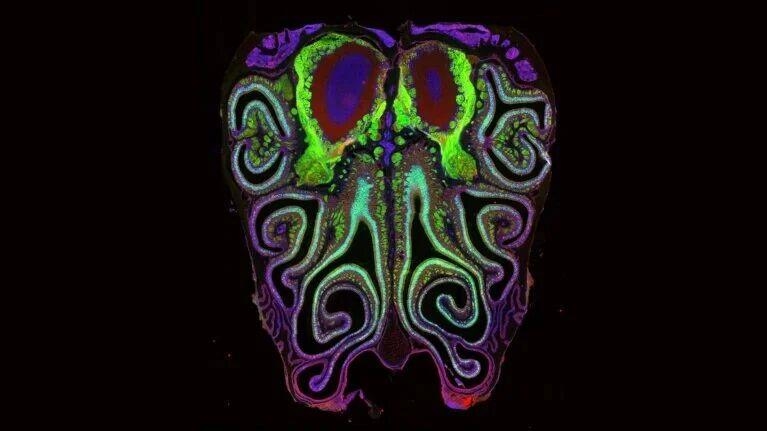
This is the world's first spatial distribution map of olfactory receptors, a breakthrough hailed as a milestone by the industry, completely overturning 30 years of olfactory cognition.
The research team analyzed approximately 5 million neurons from hundreds of mice using single-cell sequencing and spatial transcriptomics, successfully creating a precise map of the distribution of about 1100 olfactory receptors within the nasal cavity, and simultaneously revealing the rules governing their neural connections to the brain's olfactory bulb.
Previously, the academic community generally believed that olfactory receptors were randomly distributed within the nasal cavity. However, the new map confirms that each receptor occupies a fixed position, extending from the top to the bottom of the nasal cavity in horizontal stripes, with different stripes interweaving to form a highly ordered topological structure.
The study also found that the gradient distribution of retinoic acid is a key factor regulating receptor positioning, controlled by genes during development.
The map corresponds one-to-one with the processing patterns of the olfactory bulb in the brain, indicating that the nasal cavity and the brain follow the same developmental logic, enabling the olfactory system, like vision, hearing, and touch, to have a clear spatial mapping relationship.
This discovery overturns the traditional textbook model and provides a core theoretical basis for stem cell repair therapy for olfactory loss—only full nasal cavity coverage with stem cell transplantation can fully restore olfactory function.
Currently, the research team is advancing human tissue verification, attempting to establish a correspondence between odors and receptor stripes, with potential future applications in disease diagnosis, intelligent sensing, and other fields.