Yu'ebao Yield Falls Below 1% - Daily Income of 10,000 Yuan is Only About 2 Mao
As the largest money market fund in the entire market, Tianhong Yu'ebao's 7-day annualized yield has reported 0.999%, officially falling below the key psychological threshold of 1%. According to the latest data calculations, a yield falling below 1% means that the daily income for every 10,000 yuan held is less than 0.27 yuan.
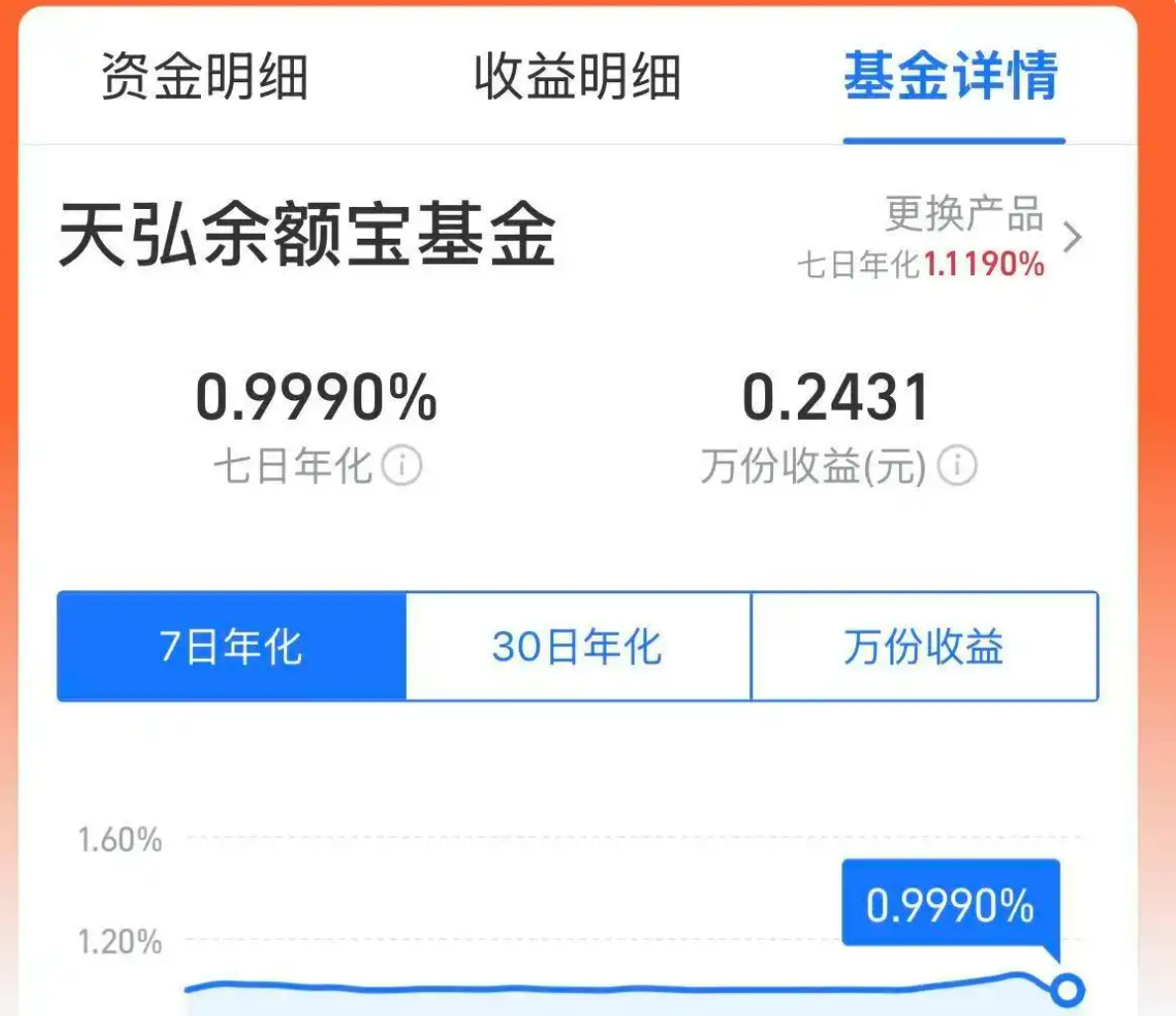
For many ordinary users who are accustomed to placing idle funds in Yu'ebao, the shrinking of financial returns has become exceptionally intuitive.
In fact, this trend is not unique to Yu'ebao. Public data shows that since the second half of last year, half of the money market funds in the entire market have seen their yields fall below 1%.
Whether it's WeChat Pay Wallet, Tian Tian Fund, or similar products on major bank platforms, they are all experiencing similar declines.
Analysts pointed out that the breaking of the 1% yield for money market funds is an inevitable result of the current downward cycle of interest rates.
The core reason lies in the continued decline in broad-spectrum interest rates, which leads to a decrease in the yield of the underlying investments of money market funds. Even Yu'ebao, with its huge scale, cannot go against the trend.
This interest rate environment has sparked discussions among many netizens. Many people bluntly say that the income in Yu'ebao is not even enough to buy a bottle of mineral water, and the motivation to save money is being constantly eroded. In the eyes of many depositors, the attractiveness of this low-threshold wealth management product is rapidly diminishing.
Faced with this market situation, investors' mentality is also changing. The past logic of pursuing stable and considerable returns on wealth management is facing huge challenges in the current interest rate environment, and finding higher-yielding alternatives has become a new choice for many people.
The collective bottoming out of money market fund yields reflects the abundance of funds in the financial market and the overall decline in the rate of return on investment targets. This also means that the era of lying down and earning stable spreads is gradually fading away with the deepening of the downward cycle of interest rates.
For ordinary people, how to reconfigure assets in this low-interest rate era has become a new challenge that must be faced. Investors often need to make more difficult trade-offs between safety and yield than ever before.