Japan Develops Cardboard Military Drone, Assembling in 5 Minutes at a Cost of $3,000
The conflicts in Ukraine and Iran have provided profound lessons for modern military forces: inexpensive, disposable drones deployed on a large scale can rival expensive precision weapons in strategic value. A Japanese startup is taking this logic to new heights by replacing traditional composite material bodies with corrugated cardboard.
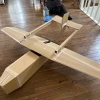
Recently, the Japanese Ministry of Defense held talks with drone manufacturer Air Kamuy, whose signature design utilizes a corrugated cardboard structure. This meeting marks the Japanese government’s desire to take a leading role in low-cost drone production, as mass-market models are reshaping the calculus of modern warfare. The Ministry of Defense’s focus is on the AirKamuy 150, a multi-purpose fixed-wing drone conceptually comparable to the American-made Lucas and Iran’s Shahed, both of which have proven their relevance on the battlefield. However, the AirKamuy 150 may be far easier to deploy than either of these.
Iran’s Shahed design rose to prominence after Russia’s 2022 invasion of Ukraine and its subsequent large-scale deployment. Its appeal lies in cost and production: the drones can be launched quickly and cost only a fraction of a Tomahawk missile. The U.S. later reverse-engineered the design, developing the Lucas drone, which was subsequently deployed to strike Iranian targets.
The AirKamuy 150 pushes the cost-effectiveness argument even further. Each Lucas drone costs approximately $10,000 to manufacture, while Air Kamuy’s cardboard design costs a maximum of only $3,000. It is also slightly faster, with a top speed of around 74 miles per hour, compared to Lucas’s 63 miles per hour, and is much lighter.
Manufacturing advantages may be as noteworthy as the economics. Hand assembly takes approximately five minutes and requires no specialized facilities, theoretically allowing any company with access to standard cardboard stock to assemble them. The fuselage can also be folded flat, simplifying transportation and logistics in the field.
To date, Air Kamuy has primarily positioned its drones for target practice, testing, and potential civilian applications such as parcel delivery and emergency response. But the Ministry of Defense’s involvement hints at a trajectory toward military applications. When the mission is a one-way flight, heavy armor becomes irrelevant. While the AirKamuy 150 has not yet been battle-tested, the company advertises “swarm attacks” as one of its potential uses. Because loitering munitions do not inherently require heavy armor, disposable cardboard may prove to be an ideal material for manufacturing them.
One significant limitation remains: range. The Lucas is powered by a traditional gasoline engine and can fly 512 miles. The AirKamuy 150 is electrically powered, with a flight time of approximately 80 minutes, a limitation that will restrict its operational range beyond short-range missions.
Despite this trade-off, the broader implications of the design are worth watching. As drones become more autonomous, the development of artificial intelligence swarm software could enable them to overwhelm traditional air defenses. Experiments over the past few months have demonstrated that large numbers of drones can operate in coordination with minimal human intervention. If cheaper materials like cardboard lower the barrier to building larger swarms, the strategic algorithms of air defense may shift again.