Microsoft to Streamline Windows 11 Edge, Starting with the Sidebar
Microsoft believes the current Edge browser is too bloated and is working to streamline it, with the sidebar being the first feature to be removed. While Microsoft hasn't fully disclosed the details of this "slimdown plan," documentation and prompts in the latest version of Edge confirm the sidebar is being phased out.
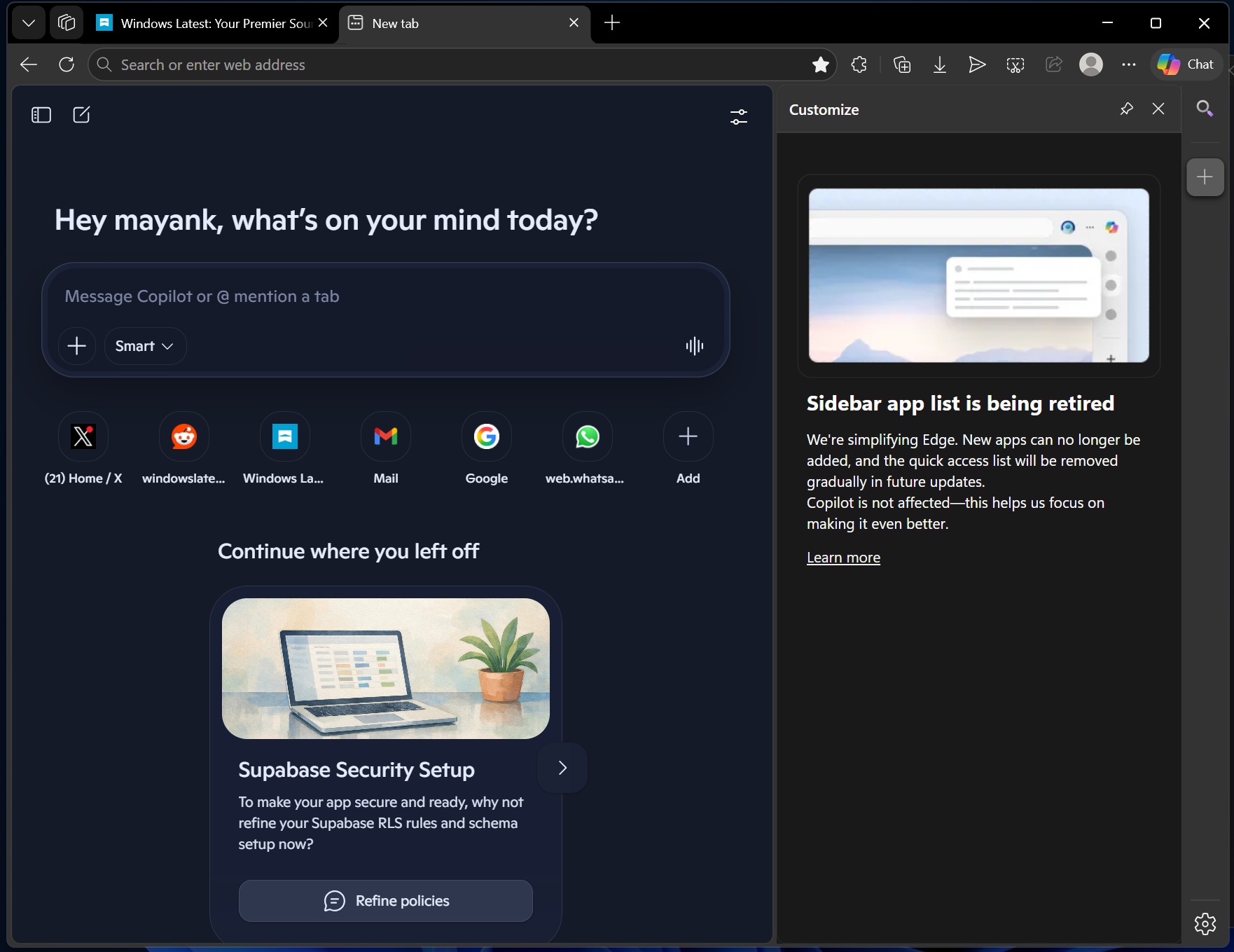
As early as November 2025, prompts appeared in the Edge Canary version indicating the deprecation of the sidebar app list, making its retirement unsurprising. However, Microsoft's wording in the latest support documentation is noteworthy: the company explicitly linked this adjustment to the overall goal of "simplifying Microsoft Edge" for the first time. Microsoft wrote in the updated support document: “We are simplifying Microsoft Edge. The sidebar app list will be retired in the near future, starting with Microsoft Account (MSA) users, with no firm retirement date yet.” This is also the first time Microsoft has publicly acknowledged its attempt to "lighten the load" for Edge.
For many loyal users, the sidebar has been a key differentiator for Edge compared to other Chromium browsers, and its removal has sparked considerable dissatisfaction. The author mentioned that dozens of users stated they would likely abandon Edge if the sidebar disappeared completely, and he found their reasons "not unreasonable." Through the sidebar, users could pin frequently used websites or web apps in "mini-program" form to the browser's sidebar, such as Outlook, Bing, and shopping websites, allowing quick access to email or shopping pages while browsing the main window – an experience not easily replicated by simple split-screen mode.
In Windows Latest’s actual testing, the sidebar is currently still available, but its departure is only a matter of time. Users can no longer add new apps to the sidebar, but previously added mini-programs like Outlook can still be used. When users try to open the sidebar, a new prompt appears within Edge: “We are simplifying Edge. You can no longer add new apps, and the quick access list will be phased out in future updates. Copilot is not affected – this helps us focus on further improving its experience.” This statement confirms the retirement path of the sidebar app list while also clarifying that Copilot will be retained in the sidebar area.
In terms of implementation, Edge’s sidebar defaults to including “Bing / Search,” so for a period of time, most users will still see this area on the browser side, but only Bing and a few previously pinned mini-programs will be usable. The sidebar is expected to be completely disabled in the coming weeks, at which point users will no longer be able to use mini-apps like Outlook without switching tabs. However, this change does not affect Microsoft’s vigorous promotion of the Copilot service in recent years. Although Copilot also runs as part of the sidebar, Microsoft has chosen to retain the sidebar area associated with it, indicating that the company will still create a fixed entry point for Copilot while "simplifying."
At a broader product strategy level, Microsoft executives are also "supporting" Edge. During the Q3 FY2026 earnings call, Microsoft CEO Satya Nadella emphasized that the company is working to regain the trust of Windows users, a goal that extends beyond Windows or Xbox to cover multiple consumer product lines, including Edge. He stated that in the consumer business, Microsoft is laying the groundwork to "win back fans" and increase user stickiness on Windows, Xbox, Bing, and Edge, and will prioritize product fundamentals and improve quality to better serve core users in the short term.
From a data perspective, Microsoft’s attitude towards Edge is not one of “laissez-faire.” Nadella revealed on the same earnings call that Edge has achieved market share growth for 20 consecutive quarters, and Bing’s monthly active users have exceeded 1 billion for the first time. However, Microsoft has not released the specific user base of Edge, nor has it provided direct comparisons with Google Chrome or Firefox. This makes it difficult for outsiders to judge Edge’s growth momentum and determine its true position in the desktop browser market.
Ironically, while emphasizing the importance of "valuing Edge" and "increasing user engagement," Microsoft is cutting features like the sidebar, which are well-received among core users. For many users who are accustomed to integrating email, search, and shopping workflows in the sidebar, this change undoubtedly increases the cost of daily operations. In Microsoft’s view, this is a step towards a simpler, more focused experience; but in the eyes of some users, losing the sidebar means Edge is slowly losing its uniqueness.