Global Q1 2026 Best-Selling Smartphone: iPhone 17 Leads as Expected
In the first quarter of 2026, the standard iPhone 17 became the world's best-selling smartphone, outperforming Android competitors and even more high-end iPhone models of the same period. The iPhone 17 series performed strongly in key markets including China and the United States, a performance confirmed in Apple's recently announced March quarter earnings – described as “another record-breaking quarter.”
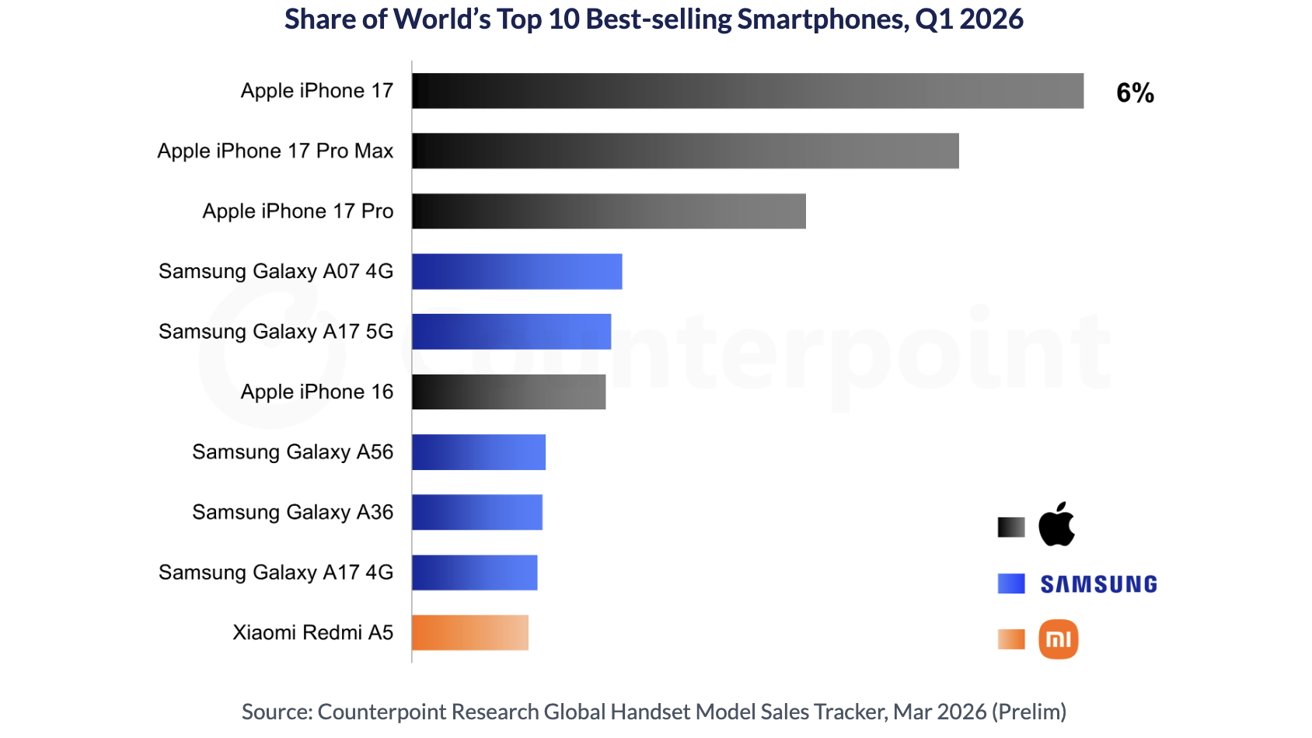
Statistics show that Apple's iPhone sales in China increased by 20% year-on-year in the first quarter of 2026, with iPhone business revenue jumping from $69.1 billion a year ago to $85.3 billion. Research firm Counterpoint Research pointed out that the main model this quarter was the standard iPhone 17, followed by the iPhone 17 Pro Max and iPhone 17 Pro. The standard iPhone 17 alone accounted for 6% of total global Q1 2026 new smartphone sales, ranking first in the global best-selling models list.
During the trade-in peak in the fourth quarter of 2025, the iPhone 17 Pro and iPhone 17 Pro Max were once the dominant models, but as 2026 began, the more affordable standard version began to take the lead, a rhythm highly consistent with the sales cycle of previous iPhones. Typically, after a new model is released in September, dedicated Apple fans and heavy users will prioritize purchasing the top-of-the-line Pro series, while in the following year, market demand gradually shifts towards lower-priced, more mainstream standard models.
The list published by Counterpoint shows that the top ten global smartphone sales in Q1 2026 are led by the standard iPhone 17 with 6%, followed by the iPhone 17 Pro Max, iPhone 17 Pro, Samsung Galaxy A07 5G, Galaxy A17 5G, and the standard iPhone 16 in sixth place. The bottom of the list also includes more Samsung models and Xiaomi Redmi A5. Overall, Apple has formed an encirclement on the list with multiple models from a single product line, further consolidating its dominance in the high-end and mid-to-high-end markets.
A key factor driving the strong sales of the standard iPhone 17 is its further narrowing of the gap with the Pro models in 2026. Reviews point out that the standard iPhone 17 is now equipped with the ProMotion high refresh rate screen previously only available on high-end models, and adopts the same screen size as the iPhone 17 Pro Max. In most daily experiences, the standard and Pro models are “increasingly close,” with the most obvious differences now concentrated on whether or not they are equipped with a telephoto camera and price level. For most smartphone consumers, the standard iPhone 17 offers a sufficiently “cost-effective” balance between cost and functionality.
In contrast, Apple's iPhone Air, which focuses on a lightweight design, did not enter the top ten best-selling global models in the first quarter of 2026. The series was once hyped by some public opinion as a “failed product,” but related reports emphasize that, from a data and project goal perspective, the iPhone Air is far from being a true failure, it’s just not a “blockbuster,” and its performance is closer to a niche product line.
Regarding this sales rhythm, the industry generally believes that this “Pro first, then standard” demand cycle may be prompting Apple to consider adjusting the iPhone update rhythm to twice a year. According to previous reports, Apple may start with the iPhone 18 series, launching the iPhone 18 Pro series first in the fall, while delaying the launch of the standard iPhone 18 until the spring of 2027. If this rhythm takes shape, it means that the best-selling model list in the first quarter of 2027 is unlikely to be led by the standard iPhone of the current season, but will be dominated by other models released earlier.
At the same time, rumors about Apple's first foldable phone are also heating up. The model, widely known as “iPhone Fold,” may debut in September 2026, or possibly be delayed until December. Even so, due to the potential release time being later than the traditional September trade-in season, the impact of the foldable iPhone on the quarterly sales structure and overall demand is expected to be relatively limited.
It is expected that under the new rhythm, the iPhone 18 Pro and iPhone 18 Pro Max will still attract high-end users and loyal Apple fans in the fall, continuing the strong sales performance of the Pro series. For Apple, the more challenging question is: when there is no corresponding new entry-level or mid-range model in the fall, how will consumers respond to this change in product line rhythm, whether they are willing to wait for the standard version update in the spring, or turn to other price levels and older products. This will become one of the key variables affecting the quarterly sales structure in 2027 and beyond.