Galaxy's "Hidden Boundary" Mapped with Precision: Star Birth Abruptly Stops Here
Astronomers have, for the first time, definitively answered how far the Milky Way's "stellar nursery" extends: star formation activity almost ceases about 40,000 light-years from the galactic center. This long-standing boundary question has now been quantitatively characterized using large-scale survey data and numerical simulations.
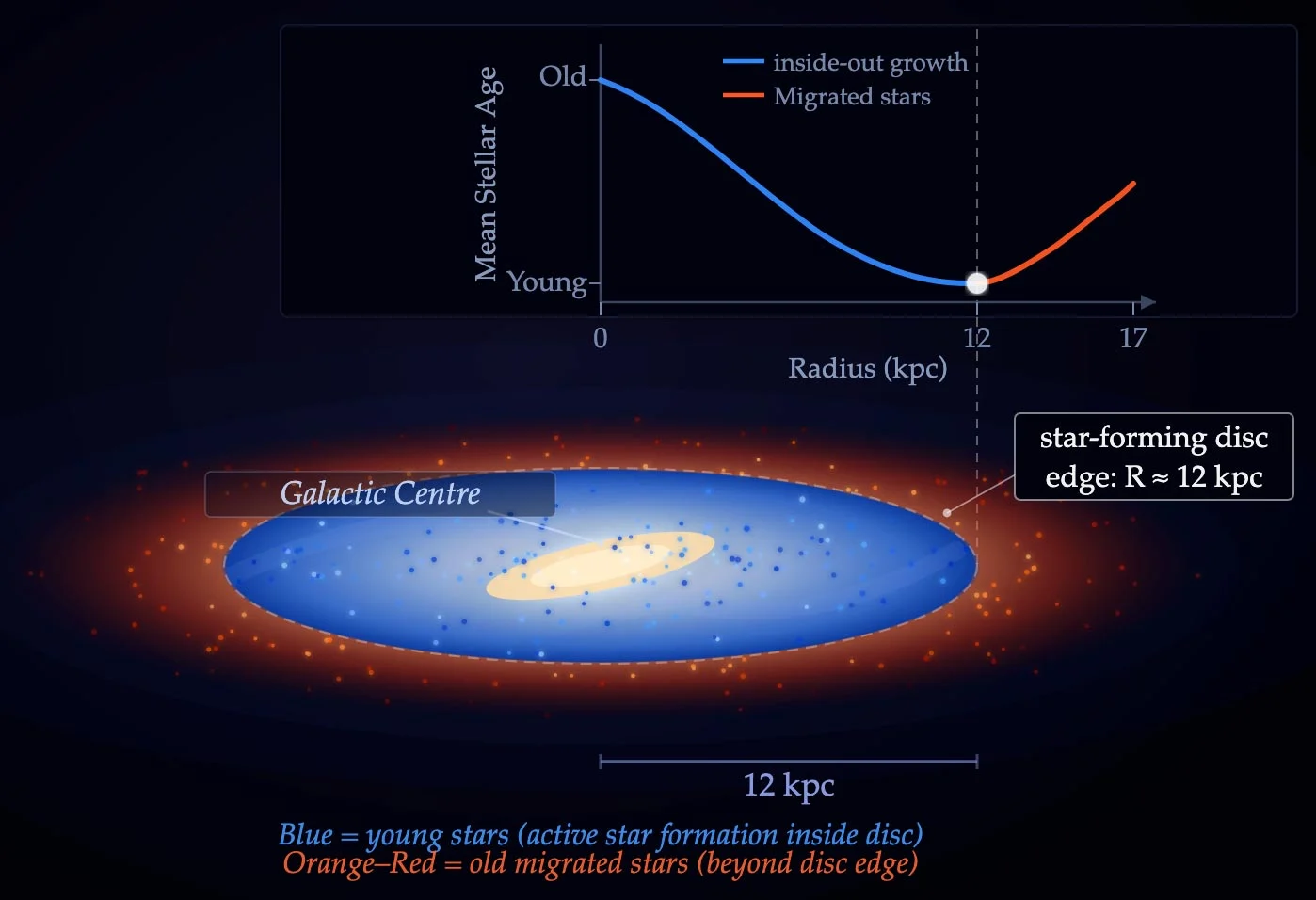
Traditionally, defining how far the Milky Way extends has been difficult, as the galactic disk doesn't simply stop like a knife cut, but gradually dims and fades into interstellar space. The latest research, by systematically determining the ages of stars, has pinpointed a clear "age boundary line," showing that the vast majority of active star formation is concentrated within approximately 40,000 light-years of the galactic center. The research team combined observational data of bright giant stars with advanced simulations of galaxy evolution, identifying a significant "U-shaped" structure in the variation of stellar age with radius, marking the outer edge of the Milky Way's star-forming disk.
Dr. Karl Fitzner, the first author of the paper and currently at the University of Innsbruck, stated that how far the Milky Way's star-forming disk extends has been one of the core unresolved questions in "galactic archaeology," and that by mapping the radial variation of stellar ages, they have finally provided a clear and quantifiable answer. The results show that the growth of the Milky Way conforms to the classic "inside-out" scenario: the high-density region at the center of the galaxy ignited star formation first, gradually expanding outwards over billions of years, with stars becoming generally younger the further away from the center.
However, this trend only holds within a specific range. The study found that before about 35,000 to 40,000 light-years from the galactic center, the average age of stars does indeed decrease with increasing radius; but once this radius is crossed, the trend suddenly reverses – stars in the more distant regions are actually older, forming a typical "U-shaped" age distribution. By comparing with high-resolution galaxy simulations, researchers confirmed that the lowest point on the age curve corresponds to a sharp drop in star formation efficiency, which is the true boundary of the Milky Way's star-forming disk. Project collaborator Professor Joseph Caruana of the University of Malta pointed out that as the precision of stellar age measurements continues to improve, this quantity is becoming a key tool for decoding the history of the Milky Way's formation, leading us into a new stage of understanding our galaxy.
A subsequent question is: if star formation weakens significantly beyond this boundary, why is the outer disk of the Milky Way still full of stars? The study's answer is the "radial migration" mechanism. Stars constantly interact with spiral density waves passing through the disk during their lifetimes, like surfers harnessing energy from waves. These gravitational "pushes" gradually move stars outwards over extremely long timescales. Therefore, most of the stars outside the boundary were not "born in situ," but slowly migrated from the inner disk; the further the migration distance, the longer the time required, and therefore these outer disk stars are generally older.
It is worth noting that these outer disk stars mostly orbit in nearly circular orbits, indicating that they were not "ejected" here by collisions with satellite galaxies or external disturbances, but are the natural result of the Milky Way's long-term evolution. Co-author Professor Viktor Debattista of Central Lancashire University pointed out that it is precisely these nearly circular orbital dynamics that prove that these stars originated from disk formation, rather than being scattered from external galaxies.
To pinpoint the star formation boundary, the research team analyzed data from over 100,000 giant stars. They comprehensively used the LAMOST spectroscopic survey from China's Guo Shoujing Telescope, APOGEE near-infrared spectroscopic observations, and high-precision position and motion information provided by the European Space Agency's Gaia satellite to statistically analyze the Milky Way's main disk stellar population. After removing the interference of complex factors such as halo components, the team successfully separated out the signal of "inside-out growth," thereby clearly mapping the contour of age variation with radius. Co-author Professor Laurent Eyer of the University of Geneva commented that the Gaia mission is delivering on its promise, and that through the combination of ground-based spectroscopic surveys and numerical simulations, astronomers are gradually restoring the history of the Milky Way's formation and evolution.
Based on the observations, the study also relied on supercomputers to simulate galaxy evolution, to verify whether the "U-shaped" age structure discovered in the observations could arise naturally. The results showed that as long as the star formation rate actually drops sharply beyond a certain radius, and old stars are allowed to migrate outwards slowly, this unique age distribution will spontaneously emerge. Co-author Dr. João Amarante of Shanghai Jiao Tong University pointed out that in contemporary astrophysical research, numerical simulations have become a core tool for identifying the physical mechanisms inside galaxies. In this work, the simulations not only helped explain the cause of the age distribution, but also allowed the team to accurately calibrate the edge of the Milky Way's star-forming disk.
Although the boundary position has been clearly characterized, the specific physical reason for the abrupt decrease in star formation at that radius remains incompletely understood. Several possibilities proposed by the study include: the bar-shaped structure of the Milky Way accumulating and redistributing gas at a specific radius, depriving the outer disk of sufficient gas supply; and the "warped" shape of the Milky Way's outer disk may disrupt the distribution and pressure conditions of the interstellar medium, thereby suppressing star formation. Currently, no single mechanism can be confirmed as the main cause, but the study emphasizes that regardless of the specific cause, this "U-shaped" age curve itself has become a reliable tracer for defining the star formation boundary.
In the future, new large-scale spectroscopic survey projects such as 4MOST and WEAVE will provide more refined stellar parameters and wider coverage samples, which are expected to further reduce the uncertainty of the boundary position and help astronomers understand what set the "red line" for the Milky Way's star-forming disk. This work also highlights an important shift: stellar age, once a quantity difficult to measure accurately, has now become an important "time scale" for reconstructing the epic of galaxy history. By tracing the formation and migration of stars over billions of years, humanity is gradually piecing together a panorama of the Milky Way's evolution from birth to the present day. The relevant results have been published in the April 2026 issue of *Astronomy & Astrophysics*, with the paper titled "The Edge of the Galactic Star-Forming Disk: Evidence from a 'U-Shaped' Stellar Age Distribution."