Domestic Supply Chain Had Privacy Screens All Along – Why Did Samsung Get There First?
Samsung's privacy screen on the S26 Ultra has garnered attention as a novel feature in the mobile industry. However, the author discovered that domestic Chinese suppliers have also been developing related technologies for years. This article explores why, despite having the technology, domestic manufacturers haven't yet launched products with privacy screens, allowing Samsung to take the lead.
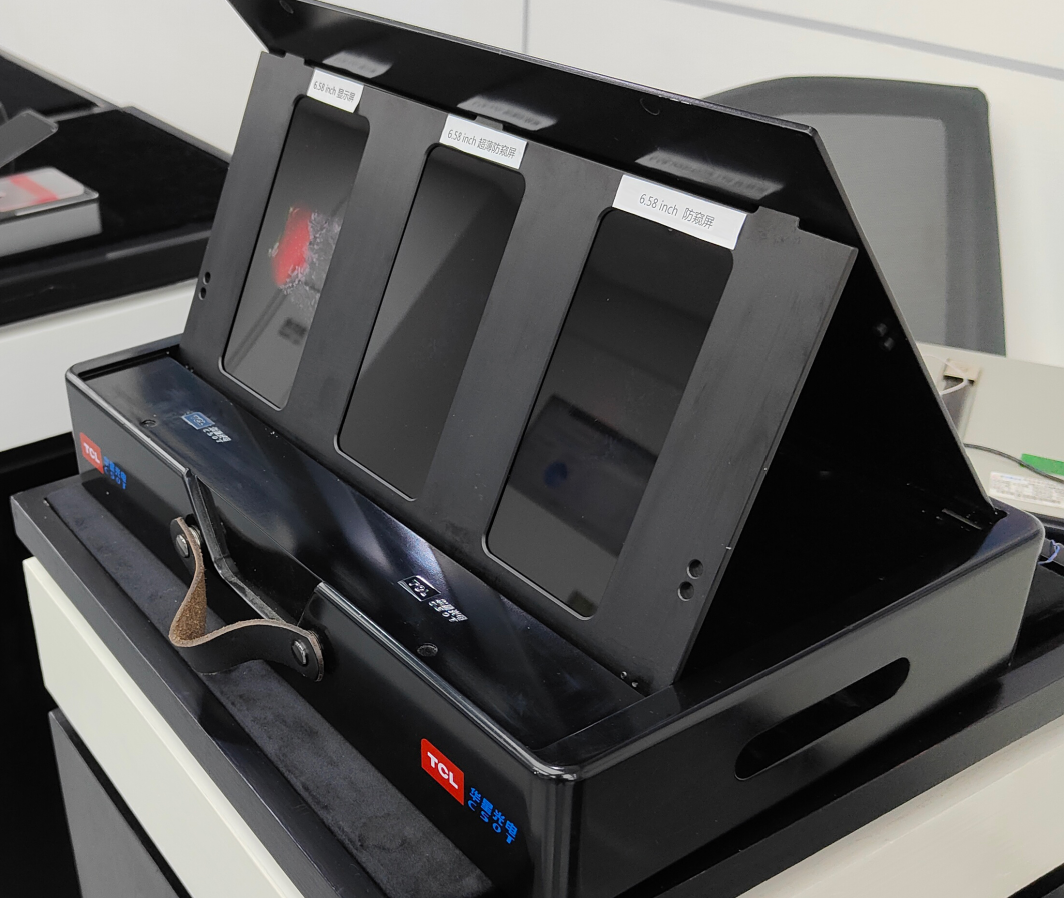
TCL CSOT and BOE have both showcased relevant technologies in recent years. In 2021, TCL CSOT exhibited a privacy laptop screen at the DTC Global Ecological Display Conference. An iteration of this technology in 2022 improved the thickness issue, resulting in a privacy screen for mobile phones.
In 2024, they also applied for a patent for an optical film structure with a viewing angle adjustment layer, allowing switching between wide and narrow viewing modes, another approach to achieving privacy.
Similarly, BOE has a privacy laptop screen composed of multi-layer privacy film materials, while privacy for car screens is achieved through a light-blocking layer and microlens structure.
So the question arises: if we can make privacy screens, why haven't related products been launched, and why did Samsung get to introduce this to the public first?
I researched the development of domestic privacy screen technology over the past two years and even examined an S26 Ultra under a microscope. I found that the two technical approaches are quite different. Domestic supply chain solutions tend to "add a layer," such as adding an adjustable voltage liquid crystal deflection layer. Applying voltage to this layer deflects the liquid crystal molecules, blocking light spilling to the sides.
Samsung, on the other hand, focuses on the pixels themselves, dividing the screen pixels into wide-angle and narrow-angle types, one emitting light more diffusely and the other more concentrated. When privacy mode is activated, the wide-angle pixels are turned off, leaving only the narrow pixels lit, thus confining the screen light to the front and making it impossible to see the screen from the side.
The biggest advantage of this method is its flexibility, directly controlling the light source. It can automatically trigger in scenarios like entering passwords or making payments. Even partially turning off wide-angle pixels can achieve localized privacy when notifications pop up.
However, it sacrifices a lot of screen quality for the privacy function.
From our pixel distribution shots, it's clear that half the pixels are turned off when privacy mode is on, effectively halving the resolution to 1080P.
Brightness attenuation is also visibly noticeable. I believe Samsung must have increased the brightness of the remaining pixels to maintain balance, otherwise the brightness drop would be too significant.
However, this increases the demands on data bandwidth and driving voltage, so Samsung had to replace this generation's 10-bit panel with an 8-bit one, reducing the bit depth to create power consumption space for "forcing higher brightness."
If you then turn on maximum privacy protection, the screen's contrast will also decrease, appearing grayish and unpleasant. Critically, even without privacy mode enabled, viewing the screen at an angle only shows wide-angle pixels, effectively discounting the viewing angle, and making it uncomfortable for everyday use.
Despite all these drawbacks, Samsung still brought active privacy screen technology to the market, and reports have emerged that domestic phone manufacturers are planning to include it in their new flagships.
Do manufacturers genuinely believe that flagship phone target users have a strong need to protect their privacy and are willing to accept a screen with less impressive display quality for the privacy function?
Theoretically, compared to Samsung's approach of turning off some pixels, the domestic supply chain's method of "adding a layer" to control the direction of screen light won't affect the screen resolution and is relatively less technically challenging and cost-controlled. So why was it implemented so late?
Because this method is equivalent to prefabricating a controllable "privacy film" on the phone screen, the thickness inevitably increases, which is a major issue for flagship phones that prioritize feel and texture. Battery space will also be slightly reduced.
Moreover, this screen will somewhat affect brightness. In the Chinese market, where parameters are relentlessly pursued, losing a few hundred nits of peak brightness will immediately put you behind the competition.
Furthermore, this solution is difficult to achieve the fine-grained control of Samsung's localized privacy. It is more suitable for large-area partitioned privacy, such as the driver-passenger partitioning of car screens. This creates a somewhat awkward situation –
Privacy screens exist, but are difficult to use on phones. Forcing it results in the function being unnecessary in the mid-to-low-end market, and not impressive enough in the high-end market.
I also asked friends in the supply chain, and it can be confirmed that domestic privacy screens are definitely being developed, but they are still in the testing phase, and there are no mass-produced products yet.
This is understandable, as there are still three major mountains to overcome from technology to implementation: thickness, brightness, and display quality. If the domestic active privacy screen technology route doesn't change, I believe the most urgent task is to make the privacy screen thinner. The latter two problems, even Samsung hasn't solved, can be put on hold for now.
Crucially, the price needs to be reduced. Look at Samsung, an international giant, which has already started using Chinese alternatives in its screens to control costs. If domestic screen manufacturers can introduce a mature alternative solution sooner, they will have a great opportunity to capture the market when privacy screens become more popular.
To be honest, in today's mobile industry where parameters are maxed out and appearances constantly change, privacy screens are indeed a selling point that can tell a new story, and it is not impossible for them to become standard on high-end business flagships in the future.
But for us consumers, after the novelty wears off, we still need to return to practicality. As one of the most core parts of a phone, is it really necessary to sacrifice so much for that little bit of privacy? The answer to this question can only be answered by subsequent sales data.