Amazon Bets on “Nobel Prize Material” Dehumidification Technology to Significantly Reduce Building Energy Consumption
With increasingly common hot and humid weather globally, the often excessively cold air conditioning environments in shopping malls, restaurants, and office buildings are becoming a typical scenario of high energy consumption. In hot and humid regions like the southern United States, the air conditioning load often comes not only from cooling but also from the large amount of dehumidification needed to prevent mold growth.
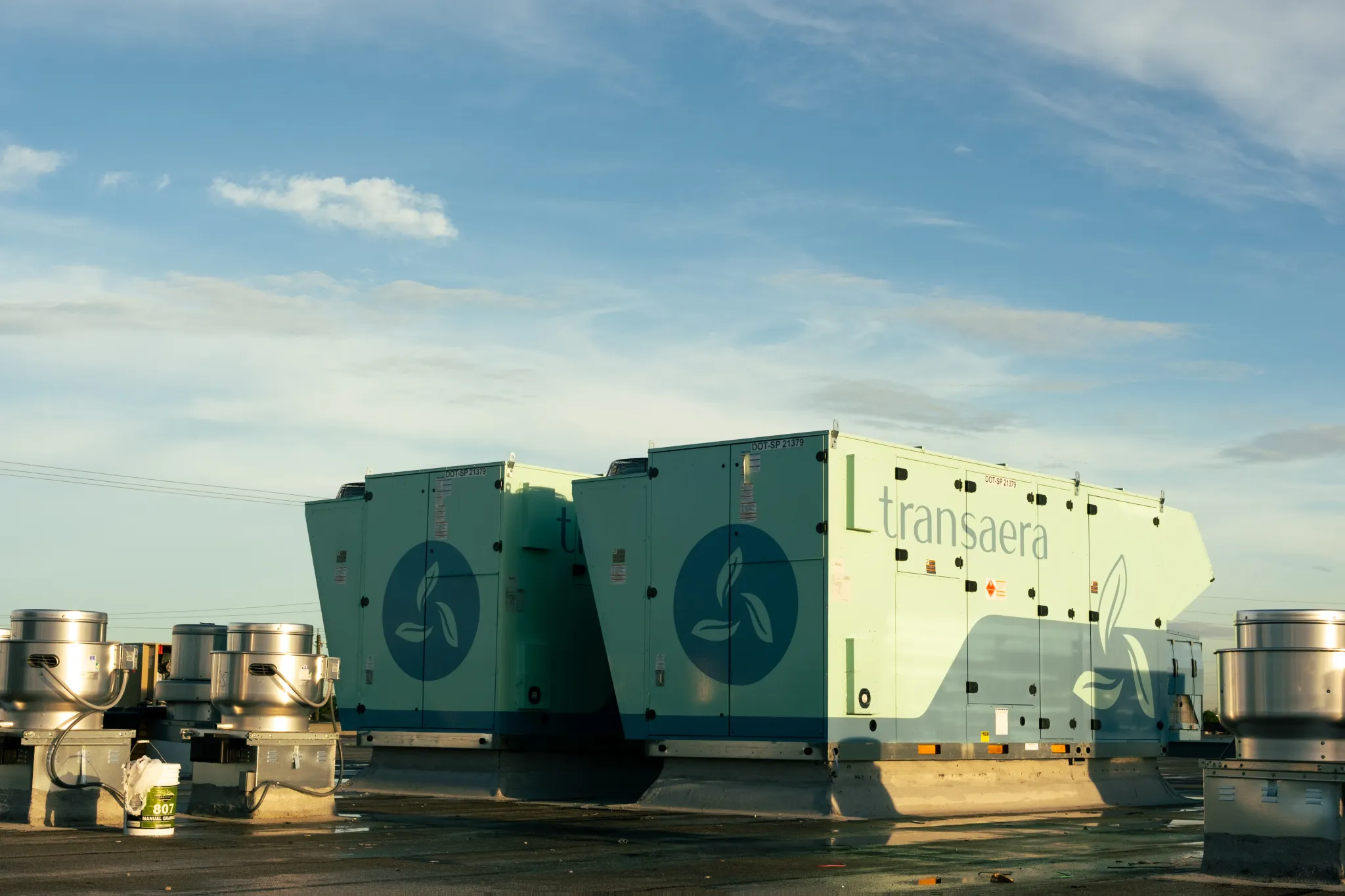
“Many commercial buildings crank up the air conditioning because they want to bring the humidity down,” says Sorin Grama, co-founder and CEO of startup Transaera, “Sometimes the air is chilled to very low temperatures, and then reheated before being sent out.”
To address this, Transaera has developed a new ventilation system that is claimed to be significantly more efficient at dehumidification than existing technologies, potentially helping users reduce energy consumption and save operating costs. Amazon has been testing the device for several months in Houston, USA, and recently signed a formal contract to become a customer. Grama revealed that the company currently has purchase commitments from various customers totaling “nine figures,” and Amazon’s collaboration has secured the company’s production capacity for the next three years. “Amazon is treating this as a design-level solution,” he said. “Once they validate a solution is effective, they will write it into their building design standards and then replicate and promote it throughout their entire building portfolio.”
The device falls into a category known as “Dedicated Outdoor Air System” (DOAS), whose core function is to significantly reduce the load on the main air conditioning system while continuously supplying fresh air indoors. A single unit can remove approximately 100 pounds of moisture from the air per hour, allowing the air conditioner to avoid prolonged high-load operation for dehumidification. The DOAS concept itself is not new, but Transaera claims its product achieves about twice the dehumidification efficiency of existing systems.
Transaera’s “secret weapon” is a moisture-absorbing material coated on a giant rotating wheel inside the device, which is approximately 6 feet in diameter and rotates continuously at a slow speed. Grama describes the material as “like silica gel, but much more powerful, like it’s on steroids.” The company has not disclosed the specific formula, only revealing that it is based on a material system that will win the Nobel Prize for its discoverers in 2025. Relevant papers and materials show that this new material has extremely high selectivity and reversibility in adsorbing moisture, and is an important breakthrough in the field of chemistry and materials science in recent years.
In terms of working principle, when outdoor air is introduced into the device, it first passes through the rotating wheel coated with the absorbent, where moisture is rapidly “pulled” from the air stream. Subsequently, the dehumidified air passes through a heat exchanger and is then sent into the building. At the same time, the stale air drawn from indoors carries heat to the other side, passing through the heat exchanger and the moisture-absorbing wheel, transferring heat to the area previously saturated with moisture. This heat releases the moisture from the absorbent material and discharges it outdoors, allowing the material to “regenerate” and enter the next cycle of moisture absorption.
Amazon says that introducing Transaera’s DOAS equipment will help the company reduce building energy consumption and advance its progress towards its goal of net-zero carbon emissions by 2040. For Amazon, which has a vast network of warehouses and office buildings, HVAC systems are a significant part of overall energy consumption, and any efficiency improvement in the dehumidification process will translate into considerable energy and cost savings in the long run.
In the manufacturing process, Transaera has chosen to partner with existing HVAC manufacturers, including US-based companies, to jointly produce the equipment. The company’s proprietary moisture absorption system can be directly embedded into commercially available HVAC units with industry standard specifications. “For many customers, this is almost a one-for-one replacement of an old device with a new one,” says Grama. “I think this ‘plug-and-play’ replacement experience is a major reason for the rapid growth in demand.”