The Strictest Smoking Control in History is Here – Which City Has the Lightest Smoke?
What happens when you want to take a clean breath of air, only to have someone puffing away next to you? In April, at a Shanghai Disneyland restaurant entrance, Mr. Zhang advised Mr. Xu not to smoke, but Mr. Xu considered the advice too harsh and punched him. After police mediation, Mr. Xu apologized and compensated. A year ago, in 2025, long lines formed at the Shanghai Disneyland security check, and a father started arguing with a smoker because his daughter had been exposed to secondhand smoke in her stroller for three hours, eventually leading to a fight.
Every cigarette lit in a public place becomes the beginning of harm and conflict.
Even in cities with the lightest smoke, every lit cigarette automatically claims its territory. When faced with secondhand smoke bullying, most people can only hide, cover their noses, endure, and suppress. If you speak up, you might be told you’re “unreasonable” or “too fussy,” or even be confronted, attacked, or cyberbullied.
Meanwhile, controls on smoking in public places are tightening across the board. Recently, the UK’s passage of a bill stating that “people born on or after January 1, 2009, will never be able to legally purchase tobacco products” surged in popularity.
What’s going on here?
I. Secondhand Smoke and Thirdhand Smoke are Depriving Me of My Breathing Freedom
Tobacco was originally a hallucinogen. Cigarettes have long been portrayed as stress relievers, energizers, and social tools – symbols of coolness, rebellion, freedom, and sexiness, and a ticket to the adult world. However, the structural issues with tobacco taxes and smoking control policies have turned every cigarette into a predicament individuals can’t escape.
Nicotine in tobacco is highly addictive. According to the World Health Organization, smoke contains over 7,000 chemicals, 69 of which are strong carcinogens. Over 8 million people worldwide die each year from tobacco-related illnesses.
Currently, China has over 300 million smokers. Even if you don’t smoke, the invisible harm of secondhand and thirdhand smoke happens quietly every day. There is no safe level of exposure to secondhand smoke, and even opening windows or using air filters cannot avoid it. Each year, over 1 million people in China die from smoking-related diseases, and over 100,000 die from secondhand smoke – a number exceeding deaths from tuberculosis, AIDS, and malaria combined.
If you can move away or object when faced with secondhand smoke, you are often powerless against the more hidden and longer-lasting thirdhand smoke.
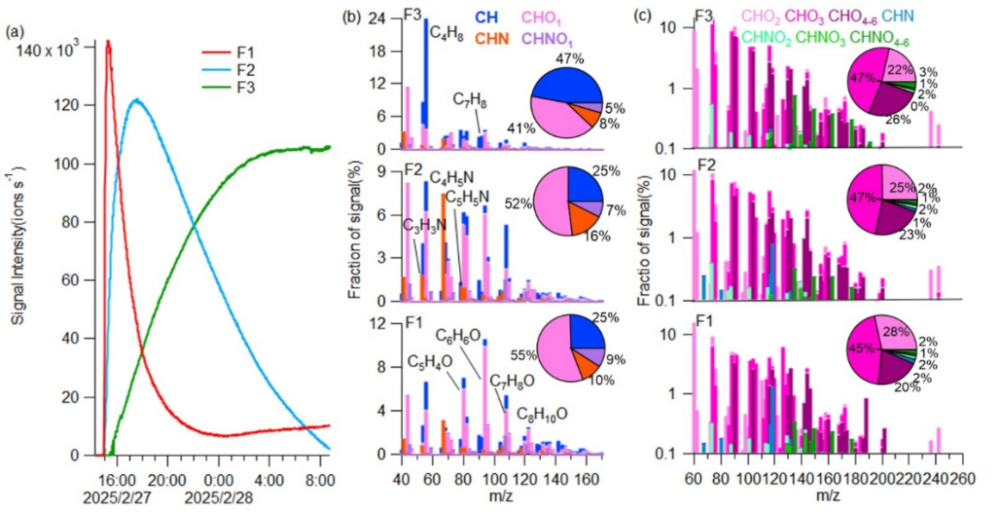
The dynamic process and spectrum of thirdhand smoke volatilization. (Image/Atmospheric Physics Institute of the Chinese Academy of Sciences)
A study published by the Atmospheric Physics Institute of the Chinese Academy of Sciences in late 2025 in *Building and Environment* refreshed public understanding: so-called “thirdhand smoke” is pollutants that remain adsorbed on walls, fabrics, furniture, etc. after tobacco smoke dissipates. They undergo complex transformations and release, forming a long-term exposure source.
The harm caused by a single cigarette can last for minutes, days, or even months. Carcinogens like nitrosamines from thirdhand smoke settle on clothes and sofas, turning every corner of the room into a potential gas chamber. Even more frighteningly, nicotine levels in the bodies of infants exposed to thirdhand smoke can be up to 50 times higher than in non-smoking households, leading to DNA damage and increasing the risk of lung cancer. Thirdhand smoke is becoming one of the most serious types of indoor air pollution.
II. Which City in China Has the Lightest Smoke?
Speaking of which, Shenzhen is considered a model student in national smoking control. In 2024, the smoking rate among people aged 15 and over in Shenzhen was as low as 17.4%, far below the national average, making it one of the “cities with the lightest smoke in China.”
Shenzhen Bao’an International Airport smoking ban signage. (Image/Shenzhen Health Commission)
According to the *Shenzhen Evening News*, the *Shenzhen Special Economic Zone Control of Smoking Ordinance* came into effect on March 1, 2014, stipulating a complete ban on smoking in all indoor public places, workplaces, and public transportation, launching a comprehensive smoking control campaign. In 2019, bus stops, subway entrances, and e-cigarettes were also included in the smoking ban. In 2022, the city completed the construction of smoke-free government offices. In 2025, it launched the nation’s first local standard for establishing smoke-free venues.
Shenzhen smoking control map. (Image/“Don’t Smoke” Mini-Program)
Shenzhen launched the “Don’t Smoke” mini-program, allowing every citizen to become a mobile “electronic eye,” and set multiple national firsts: the first 30,000 yuan fine for selling cigarettes to minors, the first 500 yuan fine for a smoker fleeing, the first inclusion of e-cigarettes in smoking ban signage, and the first pilot installation of smoking control “electronic eyes.”
*The Health Effects of Comprehensive Smoke-Free Policy Enforcement in Shenzhen* shows that in the first 2.7 years after the implementation of the smoking control ordinance in 2014, the risk of acute myocardial infarction, ischemic stroke, and hemorrhagic stroke in Shenzhen decreased by 6%, 6%, and 7%, respectively, reducing the number of corresponding cases by more than 2,000 each.
Hong Kong smoking control poster. (Image/Hong Kong Department of Health)
Hong Kong consistently ranks among the longest-lived regions globally and has strong smoking control measures.
To create a “smoke-free city,” Hong Kong banned indoor smoking completely in 2007, and the smoking rate has fallen from 23.3% in 1982 to 9.1% in 2023.
Hong Kong’s *Smoking (Amendment) Ordinance 2025* stipulates that from January 1, 2026, smoking will be prohibited while queuing for public transportation or entering hospitals, Disneyland, Ocean Park, and other designated venues, with fines of HK$3,000 for violators. The smoking ban has been extended to bus stops, parks, and within 3 meters of the entrances to hospitals and schools.
From April 30, Hong Kong prohibits anyone from possessing alternative smoking products (such as e-cigarettes, herbal cigarettes, and heated tobacco products) in public places, even if they are not smoked, it is still illegal. Once caught, the minimum fine is HK$3,000, and the maximum fine is HK$50,000 and imprisonment for 6 months. The Hong Kong Department of Health stated that the new regulations have no transition period and no “first-time exemption,” and travelers are also not exempt.
Shanghai banned indoor smoking in 2017 and, after years of effort, reduced the adult smoking rate to 18.6%. In 2025, it launched a “smoking heat map” to allow citizens to report violations with one click.
Sichuan and Xinjiang simultaneously announced their entry into a new era of smoking control on May 1. Sichuan’s new regulations stipulate a complete ban on smoking in indoor public places, with a maximum fine of 500,000 yuan for selling to minors, and a crackdown on illegally produced e-cigarettes, tea cigarettes, and flower cigarettes. Xinjiang added a flexible clause: “Reasonably avoid others when smoking in non-smoking areas,” attempting to leverage social consensus at the lowest cost.
In recent years, fines for illegal smoking have generally been between 50 and 200 yuan, with limited deterrent effect. Moreover, shop owners often turn a blind eye for fear of affecting business, and bystanders prefer to avoid trouble, resulting in more persuasion than punishment. In addition, smoking often happens in an instant, and even if someone reports it, verification and processing can be troublesome.
III. Defend Your Right to Breathe
Smoking is most strictly prohibited on high-speed trains, but platforms are a gray area. Every time a train stops, smoke rises instantly on the platform, causing people to cough.
(Image/“Don’t Smoke” Mini-Program)
For high-speed train platforms, smoking control rules vary across regions. As early as 7 years ago, “smoking control model” Shenzhen explicitly prohibited smoking on high-speed train platforms.
Similar contradictory situations appear not only on high-speed train platforms but in countless everyday spaces, such as many office building restrooms and fire escapes, which are non-smoking areas but are still littered with cigarette butts.
Some people silently discourage smoking by picking up cigarette butts. On April 21, netizen “Atitia” walked for two hours and picked up 500 cigarette butts, receiving 46,000 likes on social media. “These cigarette butts have been discarded for a long time, and you can still smell a strong pungent odor 30 centimeters from your nose.” Most of the cigarette butts were pried out from the cement crevices beside tree roots, with 35 under the most cigarette butts under one tree.
Along the way, many people looked at her, but only one Southeast Asian-looking foreigner gave her a thumbs up and said “thank you.” When passing a coffee shop, people were sitting outside, surrounded by smoke, and dozens of cigarette butts were hidden under the two trees.
The next day was World Earth Day, and “Atitia” continued to pick up cigarette butts at popular scenic spots, picking up 350 this time. “Do you know how difficult it is to promote a ban on smoking in public places? Before it is achieved, someone always has to clean up the existing garbage first,” she said. “Some people will say don’t clean up after smokers, but the cigarette butts on the ground won’t disappear just because we don’t pick them up; they will continue to pollute the environment.”
Talk show actress Zhang Hui expressed resistance with laughter. She is nicknamed “smoke alarm” because she often advises colleagues not to smoke in the unit corridor. She found that many people have been regarded as weirdos for dissuading smoking, and some people even act righteously and ask those who dissuade them to leave when smoking indoors.
In 2025, Zhang Hui customized felt pendants with slogans to discourage smoking and smoking-themed mask peripherals at her personal talk show special “Strong All Life.” “Reject secondhand smoke bullying,” “Breathing rights, my basic model,” and “Discourage smoking, you are not alone” were printed on T-shirts, worn by young people. She used humor to transform smoking control from a heavy public health issue into a statement that can be worn on the body, giving more people the courage to discourage smoking.
Ultimately, this is a battle for the right to healthy breathing. Smokers have their freedom, but that freedom should not infringe on the freedom of others to breathe healthily. This should be a freedom confined to smoking zones.
Next time, when smoke drifts over, you don’t have to hide, offer an ashtray, or say “Feel free.”
You can firmly say “Please don’t smoke.” Every statement is defending your right to breathe.
Remember: your lungs shouldn’t become someone else’s ashtray.